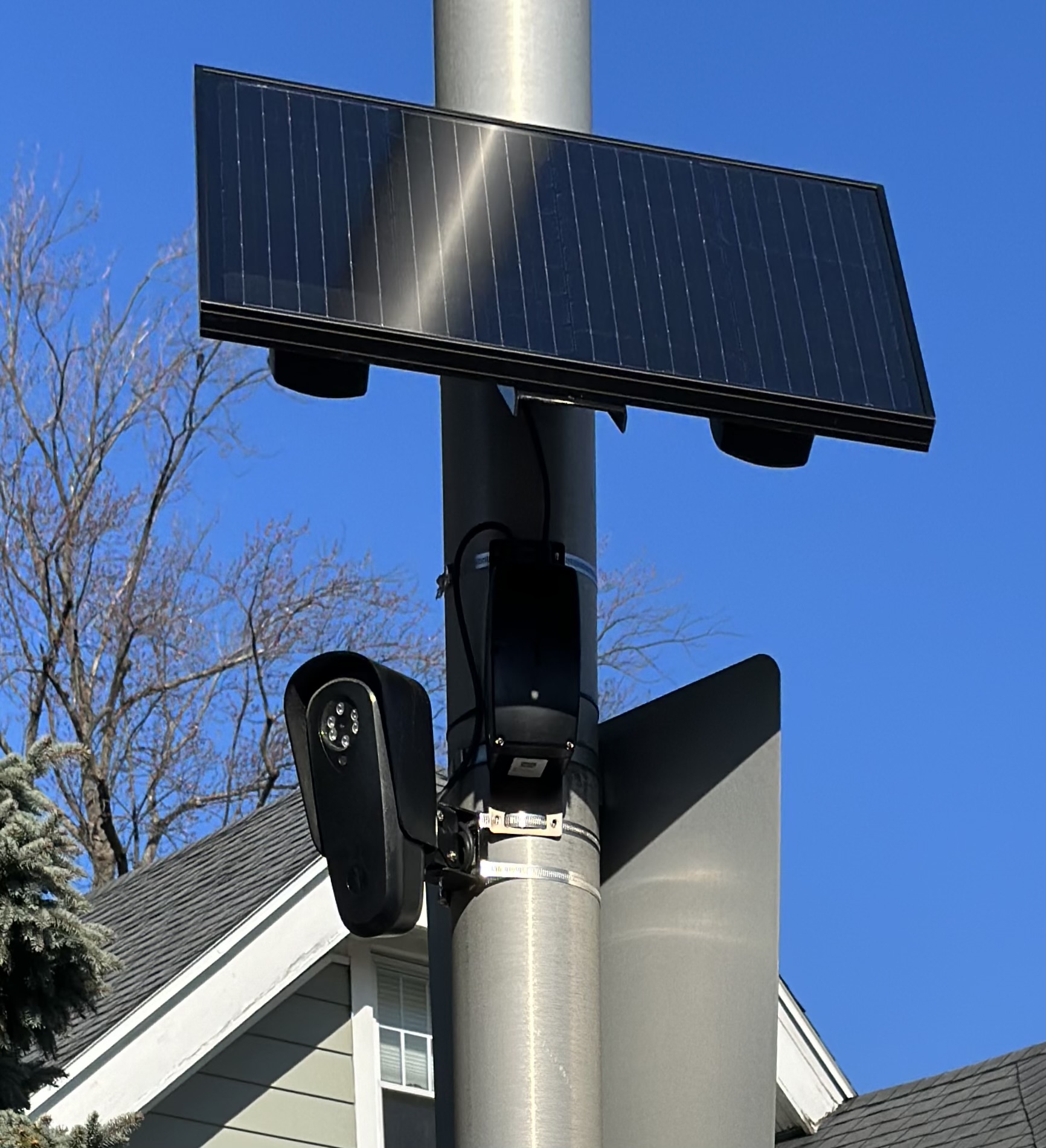
For the second month in a row, the city’s Technology Commission put off a vote Oct. 14 on asking the City Council to stop using automated license plate readers. The recommendation would also limit how long the city keeps data on residents’ movements. Commissioners said they generally support the goal but want tighter definitions and cited examples before the recommendation goes to Council. They plan to bring a revised version to their November meeting, according to the meeting video.
What changed since September. The draft posted as backup asks Council to “discontinue use of automated license plate readers, or Automatic License Plate Readers (ALPRs), in all of their forms.” It also asks that any future broad surveillance tools be accountable to residents and “do not store data at all beyond absolute need.” At the meeting, commissioners worked from a newer printed version that differed from the posted backup. The primary author, Commissioner Brian AM Williams, said the working group added language to keep the recommendation within areas the city controls, such as city vendors and contracts. It also added a closing clause asking Council to adopt a policy minimizing collection and storage of data gathered without residents’ consent, according to the video (about 00:50–00:55).
Commissioner Kevin Welch, a co-author, said the working group also pulled back language about self-driving vehicles. He said state law leaves the city little power to regulate companies such as Waymo, a point Commissioner Nicholas Eastwood had raised in September, according to the video.
Commissioners’ concerns. Discussion focused on making the recommendation precise enough for Council to act on.
- Defining the target. Commissioner Milena Pribic said the phrase “broad surveillance tools” was too vague. Pribic suggested defining it and referring back to the commission’s September 2025 recommendation on community input and commission review for sensitive technology contracts. Members agreed to move the draft’s closing language up as a definition. It covers data collected from residents without consent, especially location data that could be used to reconstruct a person’s movements or daily activities. They also replaced the word “influence” with “transparency” in that definition, according to the video (about 01:00–01:07).
- Keeping it broad. Some members discussed narrowing the recommendation to license plate readers alone. Others said a broader scope made more sense because Council has already acted on plate readers directly.
- Evidence. Several commissioners asked that each claim in the “whereas” clauses be backed by at least one cited example. They noted that published reports on Pflugerville’s plate-reader data would support one clause. Pflugerville’s City Council voted in August not to renew its Flock Safety lease after the city found that law enforcement agencies outside its partners could access its data, Community Impact reported.
The chair tabled the item at about 01:30 into the video. Commissioners agreed to send edits to Williams and city staff and to hold a smaller working session before the next meeting. The chair noted that the November meeting falls a week earlier than usual and that the commission doesn’t meet in December. Williams said he wants a recommendation the whole commission supports, however long that takes, according to the video.
Context. The Council adopted the TRUST Act in April as Ordinance 20260423-029. It requires a privacy review and Council approval before departments acquire new surveillance technology. Any recommendation from the commission would be advisory.
Other business. The commission unanimously endorsed city staff’s 2027 action plan for the Grant for Technology Opportunities Program, which funds digital-inclusion nonprofits. Under the plan, the program is consolidated into two pathways, GTOPs Core and GTOPs Mini, and the Capacity pathway goes on indefinite hiatus. Core funding stays at $320,000. Staff said a detailed communications and outreach plan for the program is in the works. The commission also adopted its 2027 meeting schedule.
What’s next. The surveillance recommendation is expected back at the commission’s November meeting. Agendas are posted on the commission’s page, and video is on ATXN.