Austin Energy has identified a need for about 400 megawatts of new on-call power by 2035 to cover the hours when the local grid is most at risk, with an estimated budget of about $1 billion. The City Council has approved a new gas-fired peaker plant to help meet that need. On Tuesday, Oct. 20, the Resource Management Commission will consider asking the Council for an independent study of whether batteries, efficiency, demand response and other carbon-free resources could complement or even replace that plant, according to a draft resolution posted as backup, which is the source of those figures. Commissioners will also hear briefings on a new battery deal with Base Power and on Austin Energy’s heat pump rebates.
The commission meets at 6 p.m. in the Shudde Fath Conference Room on the first floor of Austin Energy headquarters, 4815 Mueller Blvd. Remote speakers must register by noon the day before the meeting with Natasha Goodwin at Natasha.Goodwin@austinenergy.com or 512-322-6505, according to the agenda. The commission is advisory. Any study would require Council action.
The reliability study (Item 4). The draft resolution doesn’t name an author. It says the cost assumptions behind the utility’s 2035 resource plan and the approved peaker date to mid-2024 and have since shifted. It cites:
- a 64% increase in Henry Hub natural gas prices from August 2024 to October 2026
- gas turbine costs up 40% to 66%, depending on the type, with delivery lead times of five years or more
- house-scale battery costs down 25% to 30% from 2024 to 2026
These figures come from the draft and are not Austin Energy’s numbers. The draft would ask the Council to have the Financial Services Department hire an independent consultant through a competitive process. The consultant could have no financial ties to generation vendors and no association with members of the Resource Management Commission or the Electric Utility Commission. The study would evaluate:
- utility-scale and customer-scale batteries
- grid reconductoring and transmission upgrades to bring more power into the Austin load zone
- expanded energy efficiency and demand response
- time-of-use and real-time pricing
- vehicle-to-grid and smart electric-vehicle charging
- virtual power plants built from distributed or community solar and storage
The study would also update the expected cost and delivery date of the approved gas plant. It would test whether any mix of resources could address Austin Energy’s estimated 575 annual hours of reliability risk at or below the plant’s roughly $1 billion budget. The draft sets an October 2027 deadline and calls for the findings to go to both commissions in public meetings. It also reaffirms the commission’s support for Austin Energy’s existing efficiency, renewable and storage programs, according to the draft.
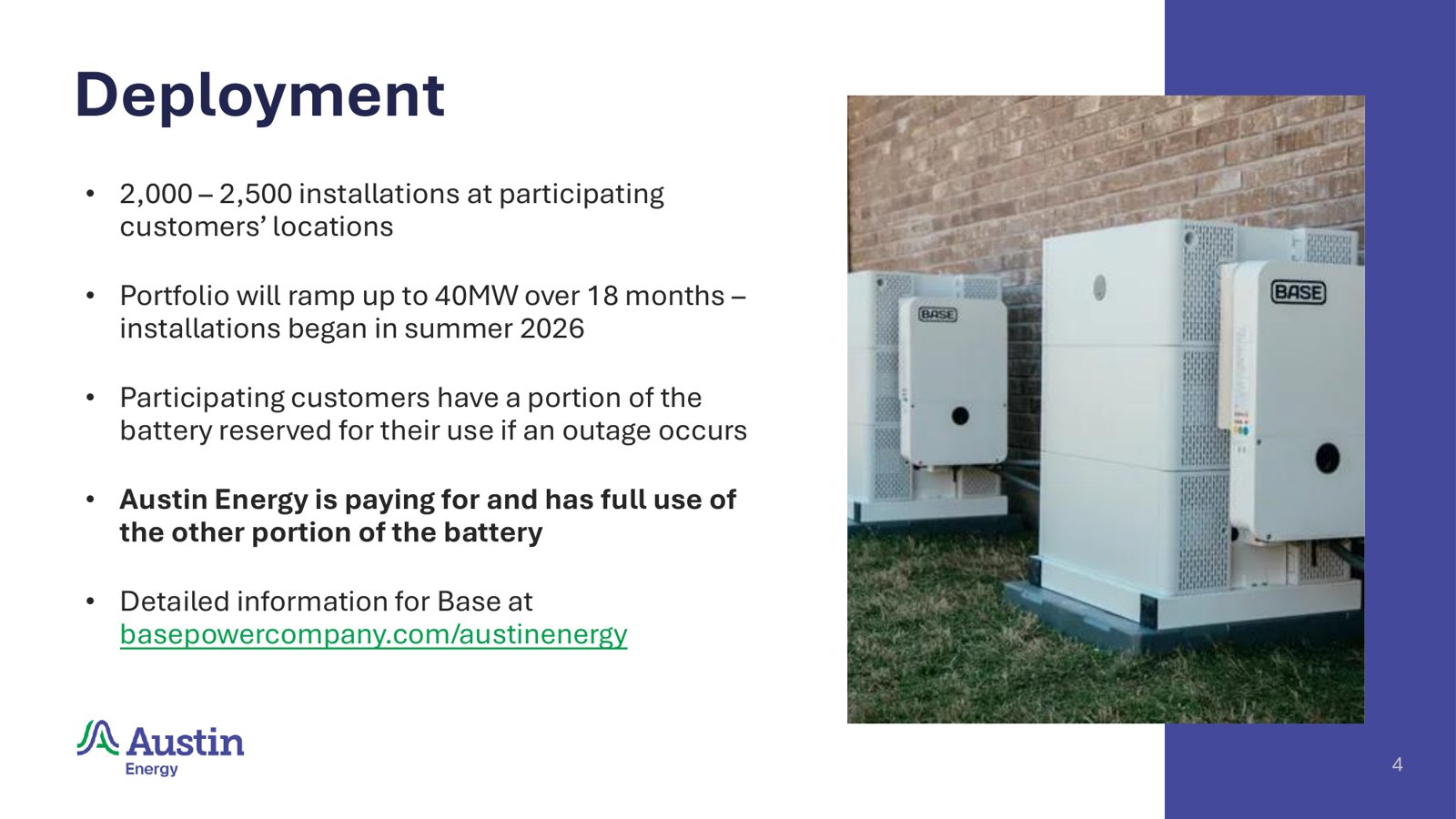
Base Power batteries (Item 2). Pat Sweeney, Austin Energy’s interim vice president for market operations and resource planning, will brief members on the battery agreement the Council approved April 23, according to the presentation.
- The 10-year deal covers up to 40 megawatts at about $4 million a year. It counts toward the utility’s 125-megawatt local storage goal.
- Base expects 2,000 to 2,500 installations at customers’ homes or businesses, ramping up over 18 months. Installations began this summer.
- Base, not Austin Energy, signs up customers and installs and maintains the batteries. The batteries sit in front of the meter, so participating customers’ Austin Energy bills aren’t affected.
- Customers keep part of each battery for backup during outages. Austin Energy pays for and controls the rest, charging when prices are low and discharging during peak periods.
Heat pumps (Item 3). Hammad Chaudhry, director of energy efficiency services, will present an overview of the heat pump program. Residential rebates for air conditioners and heat pumps range from $600 to $1,600 per unit, the presentation says. Austin Energy credits the program with more than 27,500 homes rebated and 22.5 megawatts saved over the last 10 years. Multifamily rebates run up to $400 per ton of cooling.
- The presentation lists headwinds: the loss of a $2,000-per-unit federal heat pump tax credit, the June 30 expiration of a federal tax deduction for multifamily efficiency projects, a refrigerant phaseout, and tariffs.
- It says the utility increased rebates in fiscal 2026 and will continue its 0% Velocity loan through fiscal 2027.
Other items. Commissioners will consider a proposal to automatically post an extra agenda item, starting in November, whenever a utility spending item comes before them. That would let the commission send the Council comments beyond a simple yes-or-no vote. They will also discuss control of the commission’s agenda. The joint working groups with the Electric Utility Commission on local solar and storage and on long-term storage will give updates. Members will also discuss the status of district energy and cooling, the agenda says.