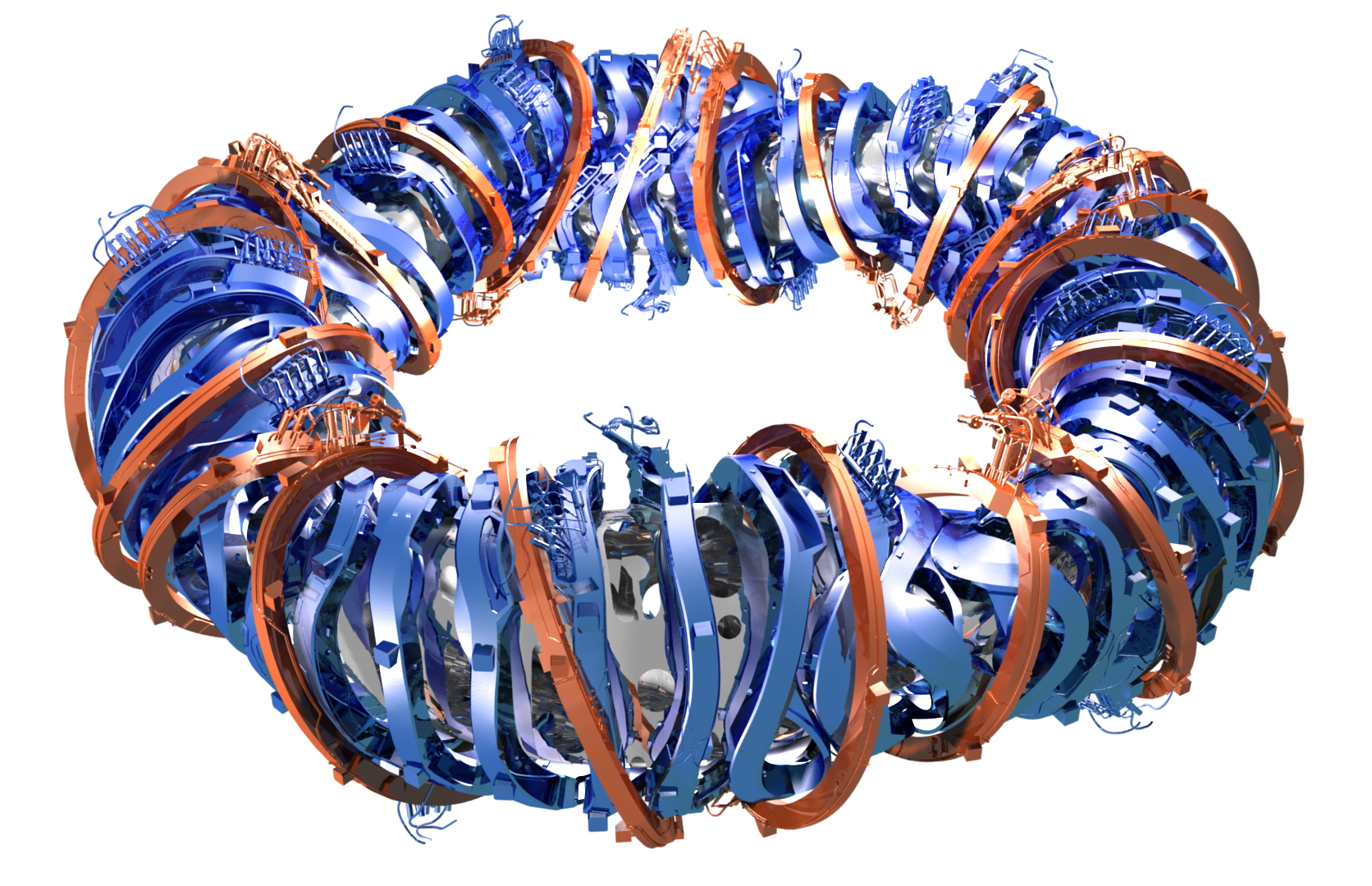
Fusion power has been perpetually a few decades away for about as long as anyone can remember. A team at the University of Texas at Austin is betting artificial intelligence can shave a little off that.
UT announced Oct. 16 that a team led by Joshua Burby, an assistant professor of physics, was selected for the Google.org Impact Challenge: AI for Science. The team will get three years of funding and support from Google’s philanthropic arm to use AI to speed up fusion energy research, according to the university.
The twisted doughnut. The project focuses on stellarators, a reactor design UT describes as “shaped like a twisted doughnut.” Stellarators use precisely contorted magnetic coils to hold superheated plasma in place. They’re a promising route to carbon-free fusion energy, UT says, but their complicated shapes make designs hard and expensive to test in computer simulations.
The UT team plans to build “surrogate models,” which are AI stand-ins that can run the same calculations much faster and cheaper than full physics simulations. UT says that could eventually lower construction costs for future fusion power plants. In its own recipient announcement, Google.org described the project as developing neural network models to accelerate the design of compact fusion reactors.
Who’s involved. The team includes faculty from UT’s College of Natural Sciences, the Department of Aerospace Engineering and Engineering Mechanics, and the Oden Institute for Computational Engineering and Sciences. Collaborators at the University of Washington and New York University are also part of the project. UT’s announcement pictures Burby with Tan Bui-Thanh and David Hatch. The university says the work grows out of one of four fusion energy seed projects recently launched with UT’s Institute for Fusion Studies.
How much money? That part is fuzzy. Google.org announced Oct. 14 that 17 organizations will share a total of $36 million and can join a six-month accelerator program with engineering support from Google. Neither UT nor Google.org said how much UT is getting. For scale, UC Berkeley said its team received $1.7 million, and Austria’s AITHYRA institute said its consortium with EPFL received $2.4 million. Both said the 17 winners came from more than 3,000 applications across 30 countries.
UT isn’t the only fusion project on the list. Germany’s Max Planck Institute for Plasma Physics, which runs the Wendelstein 7-X stellarator, also won, in partnership with TU Eindhoven, for work using physics-informed AI to model chaotic conditions inside fusion reactors, according to Google.org.
It’s a nice win for a city that already likes to call itself a tech town. Just don’t plan on plugging your EV into a UT stellarator anytime soon. The award pays for design tools, not a reactor.