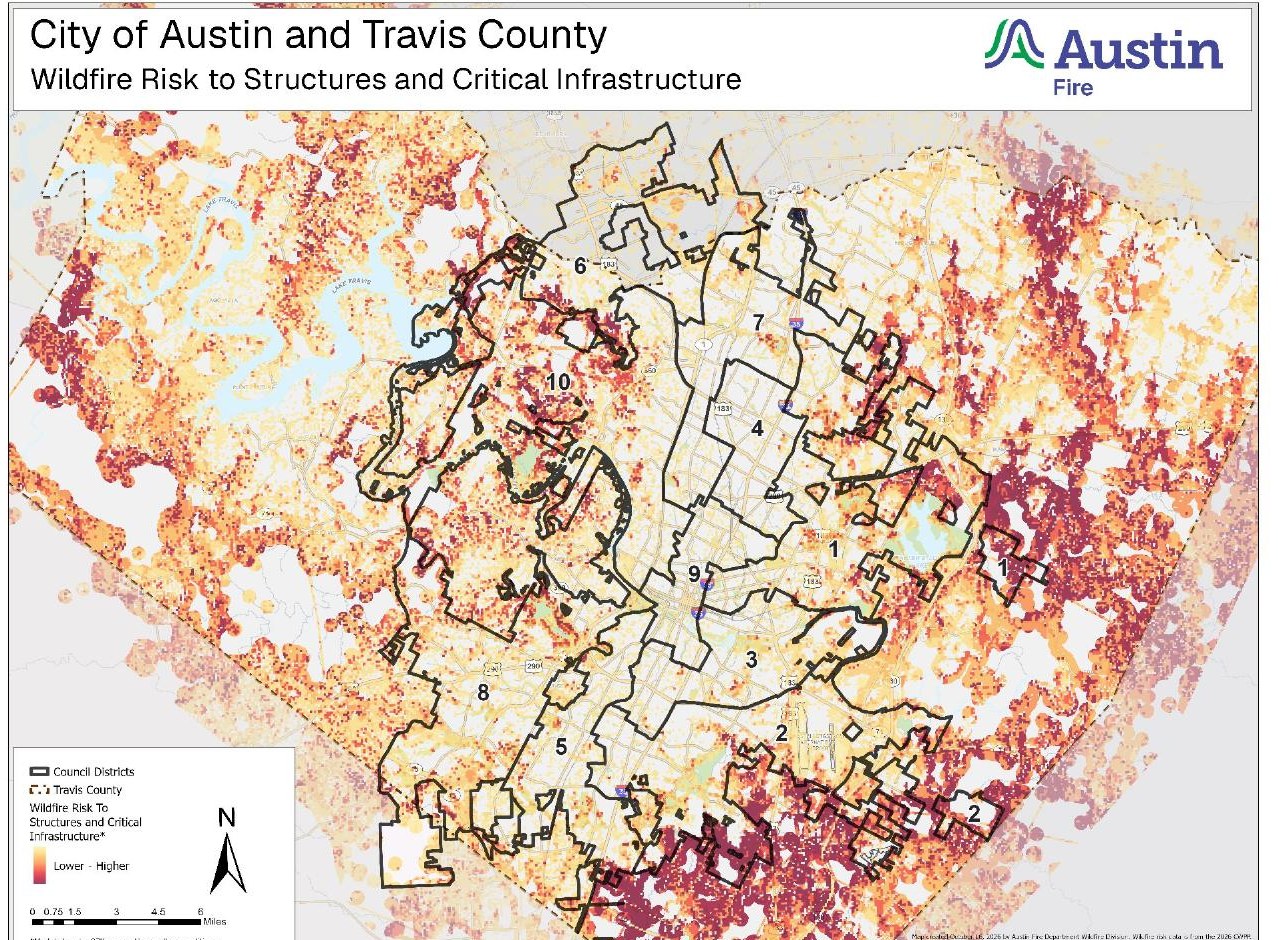
Austin and Travis County’s updated wildfire plan will guide where the region spends money to cut fire risk and keeps the city eligible for federal wildfire grants, and the Austin City Council is scheduled to vote on adopting it Thursday. At a Council work session on Oct. 20, the plan’s 71 recommendations drew questions about one in particular: a call to keep new structures, including accessory dwelling units, at least 50 feet apart.
The plan. The 2026 Austin–Travis County Community Wildfire Protection Plan updates the region’s first such plan, adopted in 2014. It was developed with the Austin–Travis County Wildfire Coalition and approved by the Texas A&M Forest Service on July 13, according to the staff request for Council action. Chris Graves, who manages the plan for Austin Emergency Management, told Council the plan is not a regulation, a parcel-level risk rating or a funding commitment, and that a current plan is required to apply for federal Community Wildfire Defense Grants, according to the meeting video and his presentation.
Highlights from the presentation:
- Fire history. Travis County has recorded 8,000 wildfire incidents since 1998. The 2011 Steiner Ranch and Spicewood fires destroyed dozens of homes.
- Work since 2014. Agencies reported 26,000 acres of fuels management, more than 6,000 acres treated with prescribed fire and more than 80,000 linear feet of shaded fuel breaks. The city also adopted a wildland-urban interface building code.
- Survey. Of 377 people who answered an opt-in survey, 77% said they were concerned or very concerned about wildfire, 45% said they did not know or were unsure how to evacuate safely, and 32% named cost as the biggest obstacle to hardening their homes. The presentation notes the survey was not a representative sample and that most respondents were older homeowners in western Travis County.
- Where the risk is. The plan’s planning-level map shows the highest concentration of modeled risk in eastern and southeastern Travis County, where continuous grass fuels support fast, wind-driven fires. Graves said the map is not a parcel-level risk rating and that only an on-site assessment can determine a property’s risk.
The spacing recommendation. The plan’s code review table lists 18 recommendations directed at local codes. One, labeled CR-5, calls on all jurisdictions to establish a minimum 50-foot separation between structures, including accessory dwelling units, “where feasible” to reduce structure-to-structure fire spread. Another, CR-4, calls for a 50-foot setback between structures and large forested areas that cannot readily be cleared.
Council Member Marc Duchen said some home builders had raised concerns about the separation distance and asked where those talks stood. Mayor Pro Tem José “Chito” Vela said applying the recommendation across Austin would effectively rule out ADUs, duplexes and other missing-middle housing, after the Council has moved toward smaller lots and setbacks to help affordability, according to the meeting transcript. He asked whether staff had studied what other code recommendations in the plan, such as ignition-resistant decking and skirting for manufactured homes and wildfire-resilient landscaping standards, would cost.
Austin Fire Chief Tom Vocke said a 50-foot separation across a city like Austin does not make sense, but that it may make sense in the highest-risk areas directly next to wildland, according to the meeting transcript. He said the department has already put in place parts of about 10 of the 18 development-related recommendations, that some are aimed more at the county, and that any code change in Austin would go through the city’s code adoption process, including affordability impact statements and meetings with builders. He said the department continues to meet with home builder and real estate groups and is reviewing private studies they have provided.
Other questions. Council Member Krista Laine pointed to high modeled risk along the Bull Creek canyon at the boundary of Districts 6 and 10, where the city owns wildland managed by Austin Water, and asked that the next briefing explain how the city is reducing fuel on that land. She also asked about participation by Williamson County, which covers part of the city, and by large private owners of grassland. Graves said Williamson County communities are on the coalition’s distribution list and that participation is voluntary. A fire official said the department’s outreach to private landowners has had varying degrees of success and that its messaging focuses on home hardening.
Capital projects update. In a second briefing, Austin Capital Delivery Services Director Adriana Castaneda and her assistant directors said the department manages 467 projects with a combined budget of $10.6 billion and has spent $2.3 billion in capital funds since it was created in 2023, according to the department’s presentation. Staff said the Convention Center rebuild remains on track for substantial completion by the end of 2028 and an opening before South by Southwest in 2029. Duchen asked why the department handles most Austin Water projects but few Austin Energy projects; staff said it mainly builds Austin Energy duct bank projects in the right of way and that talks with the utility’s general manager have begun. Assistant Director Marcus Hammer told Duchen the city remains on track to spend 90% of older bond funds in 2027.
What’s next. Council is scheduled to vote on a resolution adopting the plan as Item 11 at its Oct. 22 meeting. The Travis County Commissioners Court is expected to take up the plan on Oct. 27, and the coalition plans an implementation kickoff Nov. 6 at Austin Energy’s Mueller headquarters, according to the presentation.