A Travis County housing agency says loans from a new $15 million fund are getting two stalled affordable apartment projects built, with more of the homes aimed at lower-income families than in its past deals. A second agency told commissioners that federal funding changes could cost it rent vouchers for people leaving homelessness.
Travis County commissioners heard updates from the Strategic Housing Finance Corporation and the Housing Authority of Travis County at a work session Thursday, Oct. 22, 2026, according to the agenda and the official meeting transcript. Both agencies’ boards are appointed by the Commissioners Court.
Housing production fund: Strategic HFC created the revolving loan fund in November 2024 and capitalized it to $15 million, Executive Director Diana Gray told the court. It makes loans of up to $5 million, typically $3 million to $5 million, to close the gap between what affordable projects cost and what tax credits and first mortgages cover. Gray said higher vacancy rates and lower market rents have shrunk those other sources. The loans are paid back from project cash flow, a refinancing or a sale, with terms of up to 17 years and interest rates of 5% to 8%. “It is not a grant, but this is patient capital,” Gray said.
The fund has awarded $9 million to two projects with 527 income-restricted apartments, 161 of them for households at or below 50% of area median income, according to the agency’s presentation. The slides say both projects were stalled by financing gaps and would not otherwise have moved forward. Gray said the agency’s older portfolio was 95% units at 60% of median income.
- Rundberg Flats, a 199-unit project in Precinct 1 by Elmington Affordable, received $5 million. A quarter of the units are for households at or below 50% of median income, and 49% are three-bedroom units. Construction is set to start in early 2027 and finish in late 2028.
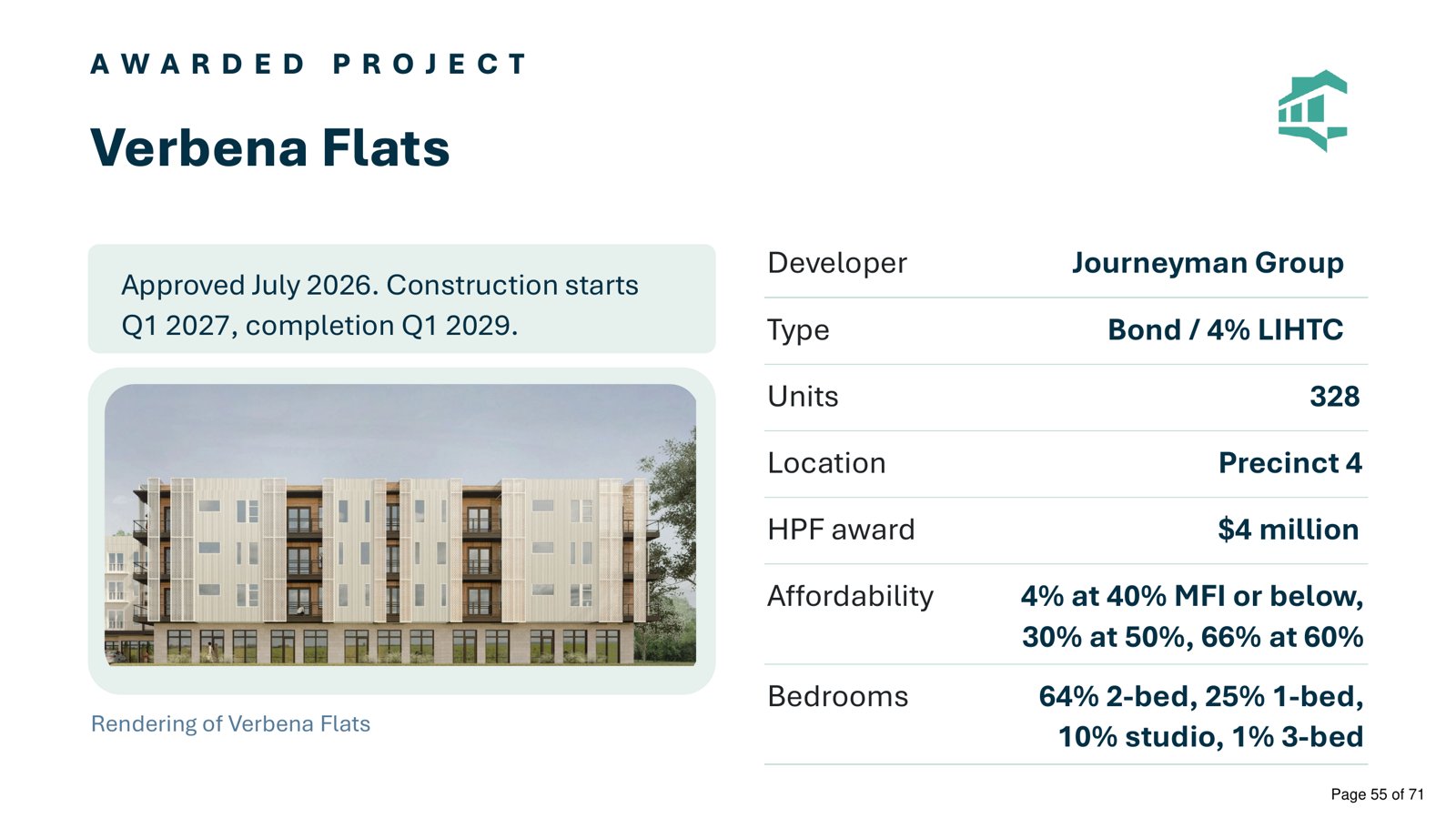
- Verbena Flats, a 328-unit project on West Slaughter Lane in Precinct 4 by Journeyman Group, received $4 million. About a third of the units are for households at or below 50% of median income. Construction is set to start in early 2027 and finish in early 2029.
Commissioner Brigid Shea asked whether the fund could help existing partner properties stay affordable as high borrowing costs squeeze the apartment market. Gray said the fund is mainly for new production, with $6 million left and a couple of projects under review. She said a separate, smaller portfolio fund is set aside in case properties in the agency’s portfolio show distress. Gray said the market is absorbing about 20,000 new units a year and that “people expect a soft recovery in latter 2027.”
Board President Ashley Huddleston said a pilot survey at Commons at Manor, a 172-unit community for residents 55 and older, found residents felt respected but only 60% said maintenance was quick. She cited 49,000 apartments delivered across the Austin area in 2024 and 2025 and a resulting need for nearly 500 more maintenance workers. “We invite the court to consider how investment in apartment maintenance training could help meet that need,” she said.
Housing authority: Housing Authority of Travis County CEO Patrick Howard said the agency has 740 vouchers, 691 Housing Choice vouchers and 49 mainstream vouchers, plus a Continuum of Care grant that houses about 74 more families. He said the federal government has told agencies in funding shortfall, including his, not to issue new vouchers, though existing vouchers continue. The agency’s slides say funding for Emergency Housing Vouchers is expected to end Dec. 31, 2026, putting 20 vouchers at risk; Howard told commissioners the agency currently has 34 Emergency Housing Vouchers. The slides also list a proposed 40% federal cut in rental assistance and HUD changes that could reduce local Continuum of Care funding by nearly $4 million.
Commissioner Ann Howard said the federal government has dropped the shortfall restriction for youth vouchers and that the city of Austin budgeted $500,000 as a match for support services. She asked the agency to apply for those vouchers, and Patrick Howard said he saw no initial problems. “And this could be a game changer for our efforts to address youth homelessness here,” Ann Howard said.
Next steps: Strategic HFC will return in the spring with a full update, and it plans to share recommendations on a housing search tool with the Austin Housing Coalition in December. The court’s next work session is Nov. 19, after the Nov. 5 session was canceled, according to the county’s meeting calendar.