Austin Water manages more than 49,000 acres of wildlands tied to endangered-species rules and Barton Springs water quality, and a City Council committee will hear how the city and Travis County are renewing a federal permit that expired in May 2026.
The Climate, Water, Environment, and Parks Committee meets at 9:30 a.m. Tuesday, Nov. 10, 2026, at Austin City Hall, 301 W. Second St., according to the agenda. Chair Ryan Alter leads the panel with Vice Chair Paige Ellis and members Mike Siegel and Marc Duchen. Some members may join by videoconference. The meeting can be watched on ATXN. Speakers may comment in person or by phone; registration instructions are on the Council Committee Information Center. Briefings are not open for speaker sign-up, the agenda says.
Item 4: Austin Water wildlands and Balcones Canyonlands Preserve. Austin Water Director Shay Ralls Roalson, Environmental Resource Officer Sherri Kuhl and Environmental Conservation Division Manager Justin Bates are listed to brief the committee on the Environmental Resource Office and Wildland Conservation Division, management of the Balcones Canyonlands Preserve and protection of water quality and quantity in the Barton Springs segment of the Edwards Aquifer, according to the agenda. An Austin Water backup presentation (File 26-3046) describes the Balcones Canyonlands Conservation Plan, or BCCP, as a regional Habitat Conservation Plan Austin and Travis County have jointly implemented since 1996 and as the city’s primary Endangered Species Act compliance tool through a federal incidental take permit.
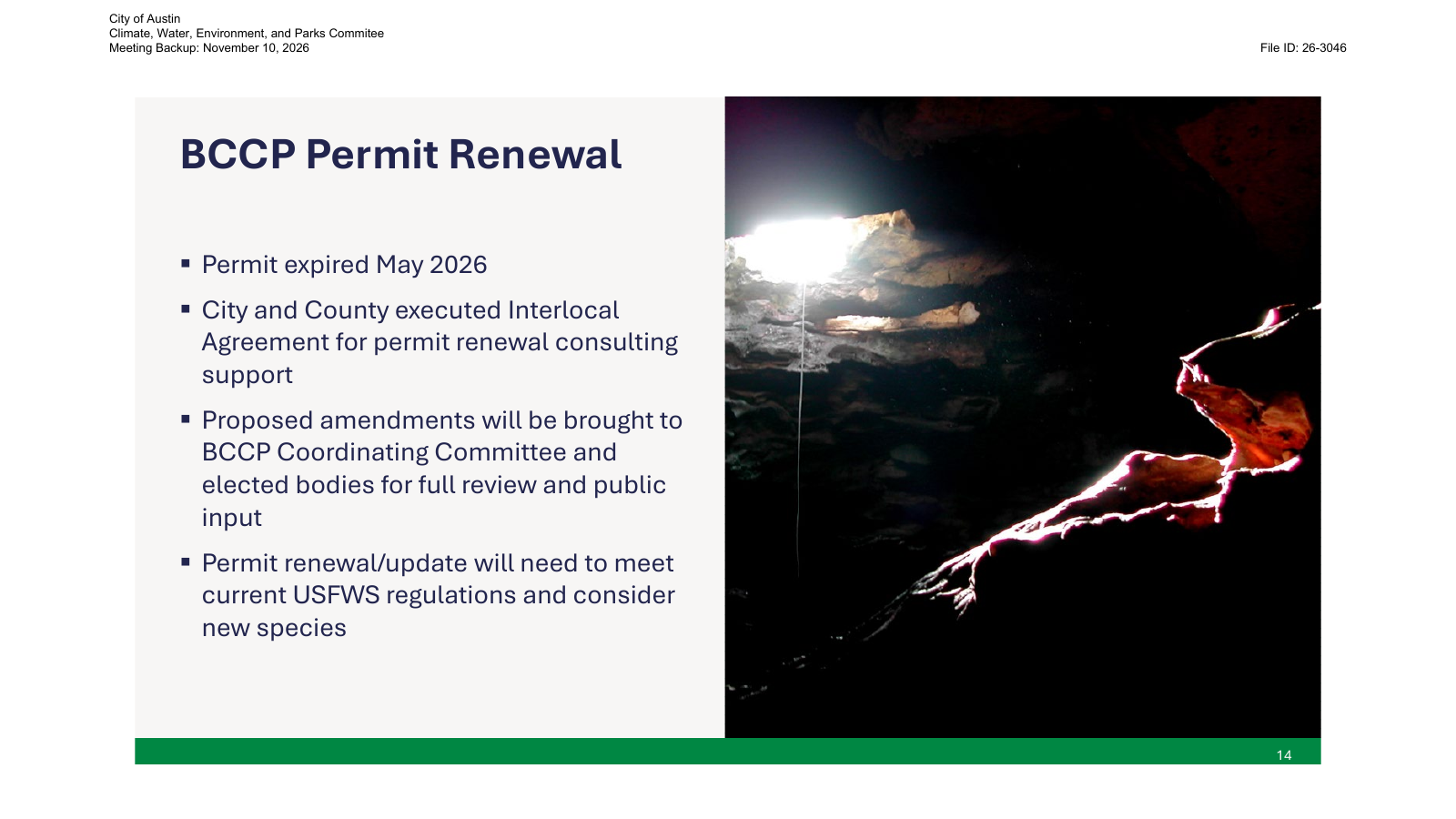
The backup says the BCCP permit expired in May 2026. The city and county executed an interlocal agreement for permit-renewal consulting support; proposed amendments would go to the BCCP Coordinating Committee and to elected bodies for review and public input; and the renewal must meet current U.S. Fish and Wildlife Service rules and consider new species, the slides say. A near-term step is forming a Biological Advisory Team and a Citizens Advisory Committee required under Texas Parks and Wildlife Code Chapter 83, with solicitation to open early in 2027, according to the backup.
On benefits, the slides say the BCCP has supported more than 1,500 development projects and more than 400 infrastructure projects and more than 12,000 acres of development while maintaining local control over Endangered Species Act compliance. Under “Wildlands Today,” the backup lists more than 49,000 protected acres — 23,000 managed directly, 3,000 of dual-purpose parkland and 23,000 of conservation easements — and more than $280 million invested in land acquisition over more than 30 years. City-owned Balcones Canyonlands Preserve land is listed at more than 13,000 acres; public areas of the preserve include Barton Creek, Mount Bonnell and Bull Creek, the slides say. Water Quality Protection Lands, established in 1998 for the Barton Springs segment of the Edwards Aquifer, are described as Austin Water actively managing land over 28% of the Barton Springs recharge zone to protect groundwater.
Item 5: Pease Park Conservancy partnership. Nicole Netherton, chief executive officer of the Pease Park Conservancy, and Christine Chute Canul, community PARKnerships manager at Austin Parks and Recreation, are listed to brief the committee on the city’s partnership with the conservancy, including future efforts to restore, enhance and maintain Pease Park, according to the agenda. The committee backup page for the item is a posting sheet without slides. Separately, Council’s Nov. 5 regular agenda includes a phase plan under the existing Park Operations and Maintenance Agreement that would expand the conservancy’s responsibilities beyond Kingsbury Commons to additional areas of Pease District Park; a Council Q&A report says the plan is not expected to generate significant direct Parks budget savings and that Parks does not have FTE positions dedicated exclusively to Pease Park. The Parks and Recreation Board previewed the phase plan earlier; see The Austin Dispatch’s Oct. 26 Parks board preview.
Also on the agenda: The committee may discuss and take possible action on its 2027 meeting schedule (Item 3). Distributed memos listed for information only include topics ranging from the Lake Austin drawdown cancellation to hydrilla in Lake Austin and a 60-day update on data center regulations.
Public communication: general is limited to five speakers who sign up before the meeting is called to order, for three minutes each on items not posted on the agenda, the agenda says.