Firefly Aerospace, the Cedar Park rocket and lunar lander company, says AST SpaceMobile will pay it more than $1.3 billion for engines, a technology license and engineering help (Firefly release). Days later Firefly reported a $94.2 million third-quarter loss (earnings release).
The deal. Firefly announced the three-year agreement Nov. 6. It will deliver 27 Miranda engines and nine Vira engines, a vacuum version of Miranda, for the first three flights of Blacklift, a heavy-lift rocket AST SpaceMobile plans to build to launch its own satellites. AST also gets a license to manufacture the engines itself. Firefly says it keeps ownership of the engine designs and can keep selling launches to other customers.
The fine print. AST’s version of the release, filed with the SEC, breaks the number down (AST release, SEC exhibit). About $800 million is upfront money for the license, half in cash and half in 10 million to 14 million shares of AST stock, with the share count set by a future average price. Another $250 million pays for engines for the first three launches and $250 million covers three years of engineering services. Because a big piece arrives as stock with lock-up periods, what Firefly actually banks will depend partly on AST’s share price. AST says Blacklift flights would start in late 2028.
Firefly CEO Jason Kim called it “a bold transformational deal for Firefly, for AST SpaceMobile, and for the space industry” in the company’s release. Firefly says the money will let it hire faster, buy long-lead materials ahead of time and add several test bays at its Rocket Ranch in Briggs, in Burnet County. It didn’t give a hiring number.
The quarter. Revenue was $110.7 million for the three months ended Sept. 30, up from $30.8 million a year earlier, Firefly said Nov. 10 in results filed with the SEC (Form 8-K). The net loss narrowed to $94.2 million from $133.4 million. Over nine months, though, the loss grew to $283.2 million from $257.3 million. The company’s adjusted EBITDA, a measure that strips out items such as stock pay, was a loss of $69.5 million for the quarter.
Cash. Firefly had $409.3 million in cash and cash equivalents at Sept. 30, down from $793 million at the end of 2025, plus $125.4 million in short-term investments. Operations used $69.7 million in cash in the quarter. After equipment purchases, free cash flow was negative $85.3 million.
The pitch. Firefly reported a backlog of $1.7 billion, up from $1.5 billion in the prior quarter, and kept its 2026 revenue forecast at $440 million to $450 million. With $309.2 million booked through September, hitting that range means $131 million to $141 million in the fourth quarter, more than the $110.7 million it just reported. The company also says it finished a spacecraft cleanroom paid for with a Texas Space Commission grant. That’s state money, though the company’s release calls it non-dilutive.
Engines still in testing. The Miranda engine AST is buying hasn’t flown yet. Firefly says it has begun Miranda’s qualification campaign and has run more than 170 hot-fire tests. The company calls that campaign a key step toward the first launch of its Eclipse rocket.
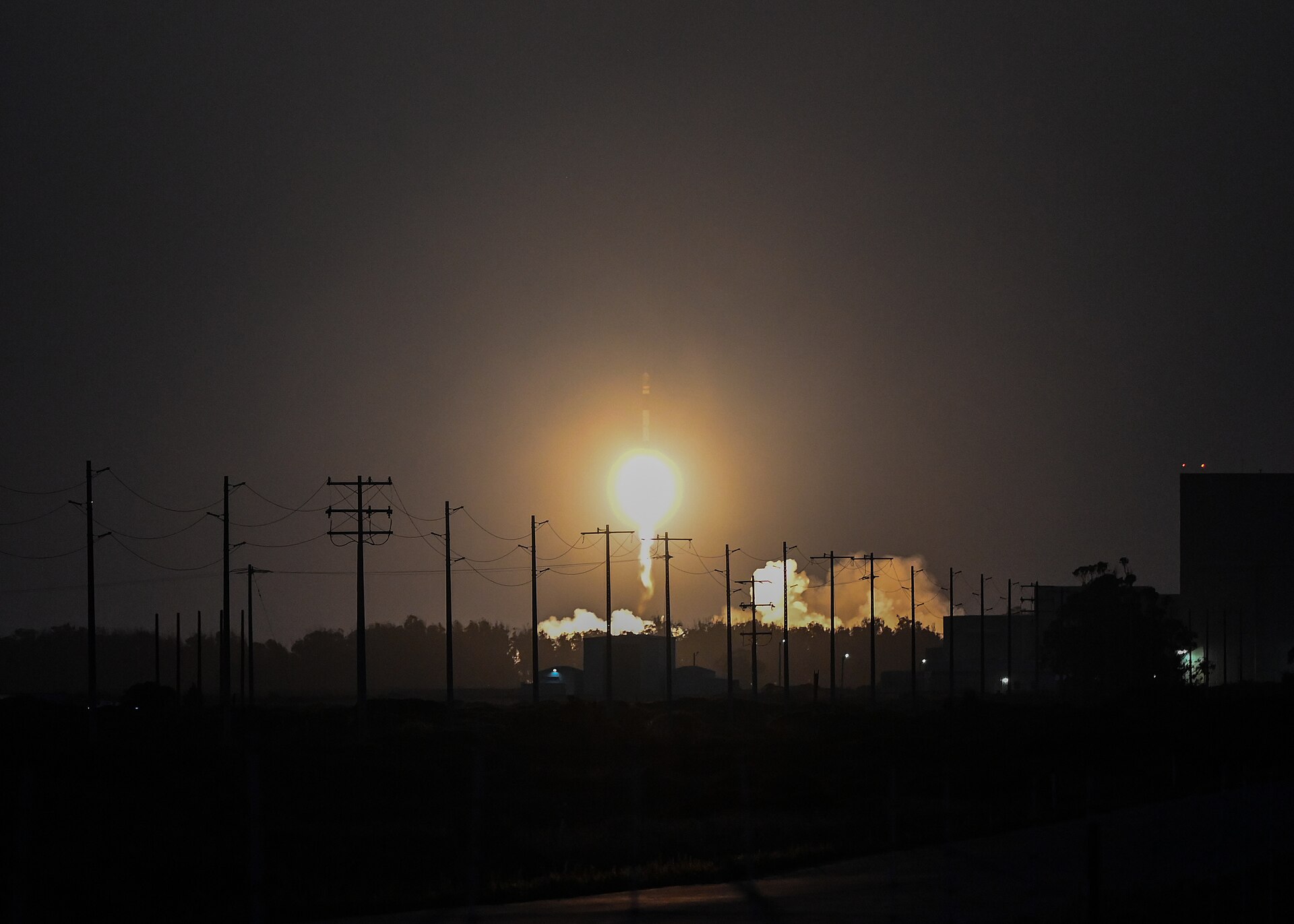
Photo: Airman 1st Class Kadielle Shaw, U.S. Space Force, via Wikimedia Commons (public domain). A Firefly Alpha rocket launches the VICTUS NOX mission from Vandenberg Space Force Base on Sept. 14, 2023.