Why it matters to you: The city spends about $48.2 million a year on the social services contracts staff just reviewed, from sickle cell care navigation to after-school counseling. Central Health plans to spend $54 million in new money on mental health care, paid in part by this year’s property tax increase. Council members get their first public look at both on Wednesday.
Preview: Austin City Council Public Health Committee, regular meeting
Wednesday, Oct. 7, 2026, 10 a.m. CT · Austin City Hall, 301 W. Second St. (some members may join by videoconference)
Meeting page · Agenda (EDIMS 482218) · ATXN live · Council Committee Information Center (sign-up)
On the agenda
The four-member committee is chaired by Council Member Vanessa Fuentes. Vice Chair Marc Duchen and Council Members Ryan Alter and José Velásquez are the other members. Fuentes and Duchen sponsor all three main items.
- PHC001 and PHC002, minutes. Approve the Sept. 2 minutes (EDIMS 482567). The committee will also approve corrected minutes for eight past meetings, from May 2024 through February 2026. The corrected minutes are posted as separate backup files on the meeting page.
- PHC003, social services strategy (discussion and possible action). Backup: a Sept. 24 staff memo with 401 pages of contract-by-contract decision sheets (EDIMS 482222).
- PHC004, No Wrong Door (discussion and possible action). Backup includes the deck from the council’s Oct. 6 work session (EDIMS 482576), a combined memo file (EDIMS 482577) and an Aug. 3 staff memo (EDIMS 482224).
- PHC005, Central Health briefing. Topics are the hospital district’s 2025-26 “Year of Access” results, its 2026-27 budget and its mental health care planning (presentation, EDIMS 482578).
- PHC006, items for future meetings.
Social services: 133 contracts, none cut, 27 to be changed
In August, the council passed Resolution 20260812-022. It asked the city manager to review the social services agreements that proposed FY27 budget cuts could affect. For each one, staff were to recommend whether to maintain it, modify it or reduce it, and tell providers before Oct. 1.
The Sept. 24 memo reports that staff from eight departments reviewed 133 agreements worth about $48.2 million:
- Maintain: 106 agreements, $39.7 million (82% of the money reviewed)
- Modify: 27 agreements, $8.5 million (18%)
- Reduce: none
Departments flagged compliance concerns on 26 agreements, or 20%. Those concerns can be administrative, financial or about the program itself.
Staff told vendors their current contracts will be kept or extended so services don’t lapse. Staff also told every vendor that all social services agreements may be modified or re-bid over the next 12 months, with new agreements starting by Oct. 1, 2027.
The memo calls this review one part of a broader reset of the city’s social services portfolio. That reset was called for under Resolutions 20260226-056 and 20260812-014. A working group is due to finish it by the end of December, ahead of the FY28 budget. Staff will report on the 27 “modify” agreements through quarterly updates to council committees.
What the decision sheets say. The attachment has one sheet per contract. Some examples from sheets marked “Modify”:
- Sickle Cell Texas Marc Thomas Foundation, Sickle Cell Navigation Services ($349,710). The city provides all of the program’s funding. The sheet cites compliance problems “including inflated performance reporting,” along with unallowed costs, ineligible clients served and multiple corrective action plans. The program would continue in FY27 under closer monitoring. Staff expect another corrective action plan and repayment, and plan to re-bid the service.
- Austin Chamber of Commerce, Opportunity Austin ($175,000). The recommendation reads “Cut by $50,000.” The sheet says performance deliverables are “currently undefined.” It recommends refocusing the work on business retention and expansion and says the city contract is about 3% of the chamber’s annual operating revenue.
- Equidad ATX, LiveWell ViveBien ($63,000). The sheet recommends a “new vendor or to end program due to unproven deliverables.” It says a retrofitted bus meant for the program has not operated since 2020 and its launch target has been moved repeatedly.
- Other “Modify” sheets include:
- Austin Area Urban League financial assistance ($698,351)
- Austin Child Guidance Center ($188,140)
- Catholic Charities counseling ($99,450)
- Communities In Schools ($81,000)
- Easterseals Central Texas behavioral health ($169,823). This sheet notes a corrective action plan and a possible reduction.
- Out Youth ($53,320)
- Mainspring Schools ($61,200)
- Rise Center, Black mothers’ program ($122,514.30). The recommendation for this one is an increase back to an earlier funding level.
Background: A July 30 staff memo (EDIMS 478172) laid out an earlier proposal that would have reduced 53 agreements by $3.3 million and eliminated 24 others worth $2.12 million. Community Impact reported that at a Sept. 22 council discussion, Alter said that recommending no cuts after staff found performance problems could hurt the credibility of the city and of the organizations involved. Mayor Kirk Watson, who sponsored the call for continued social services reviews, said the city should protect current investment levels while reconsidering how the money is best used, according to the report.
No Wrong Door: same packet, one new slide
PHC004 comes one day after the full council’s Oct. 6 work session briefing on No Wrong Door. That program coordinates police, medics and caseworkers around the people who use crisis services most often.
The “Combined Memos” file (EDIMS 482577) has the same text as the packet posted for the work session (EDIMS 482539). That packet holds a Sept. 30 coalition letter asking the city to limit the police role in the program, plus a staff response.
The presentation (EDIMS 482576) is the version shown Oct. 6. It adds a slide, credited to Central Health, called “Proposed Mental Health Continuum.” The slide lays out three phases:
- Phase 1, accelerated expansion: 10 hospital psychiatric triage/emergency beds, 22 psychiatric inpatient beds and 16 crisis residential beds at the Herman Center.
- Phase 2, a Mental Health Crisis Center:
- psychiatric triage for 40 adults and six youths
- 16 adult extended-observation beds
- sobering and withdrawal space with 40 recliners and 20 single rooms
- 48 adult and 12 youth inpatient psychiatric beds
- 16 adult crisis residential rooms
- Phase 3, a justice annex: triage, extended observation and sobering/withdrawal space for people involved with the justice system.
- Step-down care: 50 crisis residential beds and 50 crisis respite beds.
At Tuesday’s work session, council members heard about how people are added to the program’s list and what happens to the information it collects. That was reported by Austin Current and Austin Politics. Austin Current reported that the program began in March and involves 17 agencies and four Austin police officers. It said about 40 people have signed consent agreements. It also reported that Bradley Hargis of the Capital Area Private Defender Service told council members that a be-on-the-lookout alert issued by the program led to a person’s arrest on a felony drug charge instead of diversion. Maris Herold, the Austin Police Department’s chief of strategic initiatives, confirmed the incident but described it as a success, saying the team had secured a treatment bed and kept seeking the person after the arrest, Austin Current reported. Homeless Strategy Officer David Gray said a change is underway to put mental health professionals in charge of participants’ treatment plans, according to the report.
Central Health: $54 million for mental health
Central Health is the hospital district for Travis County. Its presentation (EDIMS 482578) lists these presenters:
- President and CEO Dr. Pat Lee
- Dr. Manuel Martin, secretary of the Central Health Board of Managers
- Perla Cavazos, chief governance and government affairs officer
- Monica Crowley, chief strategy/planning officer and senior counsel
- Sydney Harris, senior consultant for health systems design
Figures from the deck:
Who it serves and wait times
- More than 200,000 residents served, about 1 in 6 people in the county.
- New patients wait about eight days for a primary care visit at sites in its Open Access pilot, and about 20 days systemwide.
- Primary care visits rose 34% from 2021 to 2025, to about 670,000.
- Its medical respite program is credited with a 69% drop in hospital stays.
- 140,196 people enrolled in its Medical Access Program.
The budget
- The FY2027 budget totals $1,015,330,858. The health care delivery budget is $591.6 million.
- $28.6 million for strategic initiatives, paid for by what the deck calls “the 6% tax rate increase.”
Mental health money
- $127.5 million for crisis and recovery care, including $54 million in new mental health spending. The deck estimates the median Travis County homestead pays about $36 more a year.
- How the $54 million breaks down:
- $33.1 million for 22 inpatient psychiatric beds and 10 psychiatric emergency bays
- $16 million for the Mental Health Crisis Center ($3 million for a sobering center, $13 million for planning, start-up and operations)
- $1 million for a crisis care team
- $1 million for long-acting injectable medications
- $1.5 million for primary care for people involved with the justice system or with complex needs
- $1 million for medication-assisted treatment
- $400,000 for Integral Care’s psychiatric emergency services, already in the base budget
Clinics: The deck lists clinic projects at Hancock, Colony Park, Cameron Center and Northview. Hancock Phase 2 is set to open in January 2027.
How to take part
Speakers may sign up for items posted for possible action, PHC003 and PHC004. Briefings, such as the Central Health presentation, are not open for sign-up. General public communication is limited to five speakers at three minutes each.
Speakers may register for an item once, in person or by phone. Instructions are on the Council Committee Information Center page. Watch live on ATXN.
Disclosures
- Central Health presenter Dr. Manuel Martin is an officer of the Central Health Board of Managers.
- The Capital Area Private Defender Service, whose attorney testified at the Oct. 6 work session, works under Travis County contracts. On Sept. 29, the Commissioners Court approved an interlocal agreement for the city to partially reimburse the county’s CAPDS Forensic Project.
- No committee member’s affiliation with an organization on the agenda is listed in the backup.
What to watch
- Does any action under PHC003 change the staff recommendations, or do they stand as presented?
- The memo reports zero “Reduce” recommendations, while the Chamber sheet says “Cut by $50,000.” Under the memo’s definitions, a “Modify” can change an agreement’s funding while keeping funding for the service area. If the cut goes ahead, where would the $50,000 go?
- What happens to the Sickle Cell Navigation contract if the repayment and the new corrective action plan are not resolved before the re-bid?
- Which of the 26 agreements with compliance concerns are on corrective action plans now, and will the quarterly updates name them?
- Does anything new come out of PHC004 after the Oct. 6 briefing? Does the committee respond to the coalition’s request to limit the police role?
- Central Health’s deck describes the $53.6 million in one-time money two different ways. Slide 18 lists $22.1 million in maintenance-and-operations money above the no-new-revenue rate, an $18.5 million Hancock parking settlement and $13 million in contingency. Slide 27 lists $18.5 million plus a $35.1 million “appropriated contingency reserve.” Which is it?
- What is the timeline and location for the Phase 2 Mental Health Crisis Center, and which agency would run it?
Public reference numbers:
- Agenda EDIMS 482218
- Social services memo EDIMS 482222 (Resolution 20260812-022, resolution document EDIMS 479270)
- July 30 memo EDIMS 478172
- No Wrong Door deck EDIMS 482576; combined memos EDIMS 482577 (same text as EDIMS 482539); Aug. 3 memo EDIMS 482224
- Central Health deck EDIMS 482578
- Sept. 2 minutes EDIMS 482567
Primary sources: Meeting page · Social services memo and decision sheets · No Wrong Door deck · Combined memos · Central Health presentation · Oct. 6 work session
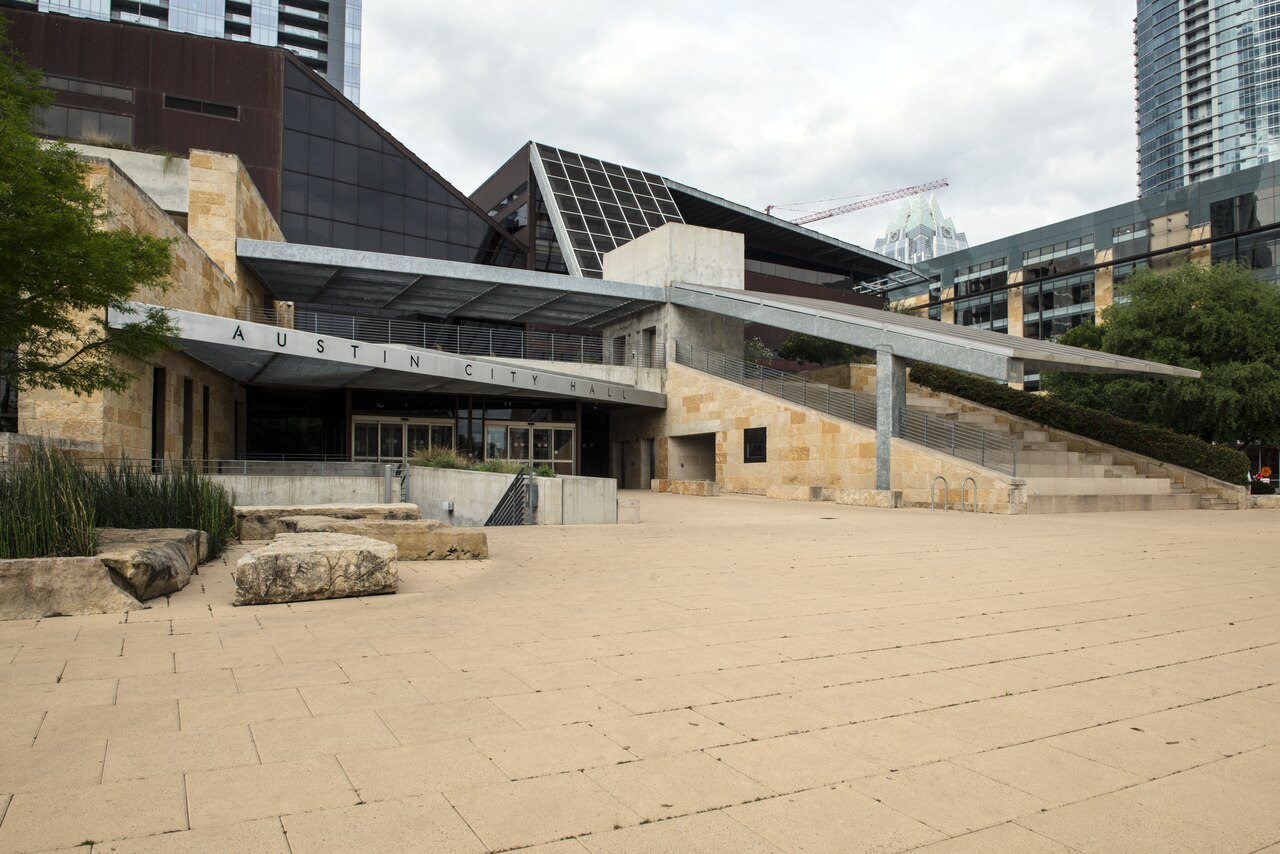
Photo: Austin City Hall and its public plaza. Carol M. Highsmith, Library of Congress (LCCN 2014632502), public domain, via Wikimedia Commons.