If you test below college-ready in math or English at Austin Community College, Texas law says you must take a support class alongside your first credit course. A staff design team told trustees Oct. 5 that the system for placing students in those classes is slow, manual and confusing. They proposed changes that would affect how thousands of new and returning students start college, including making the state placement test count for less.
The Austin Community College District’s Theory of Change design team on co-requisite courses presented its final recommendations to trustees in a work session Oct. 5, saying most students required to take the courses never enroll in them. The board took no vote. The recommendations now go to an implementation team that will decide which pieces ACC adopts, Trustee Stephanie Gharakhanian said during questions, and presenters agreed.
Under a 2017 state law, House Bill 2223, students who have not met Texas Success Initiative (TSI) readiness standards must take a developmental support course in the same semester as a related credit course, rather than taking remedial classes first. At ACC, that means pairings such as Integrated Reading and Writing (INRW) with English Composition I, or a math support class with Contemporary Math or Elementary Statistics. The packet lists more than a dozen possible pairings.
Most required students don’t enroll. The team’s data slide in the work session packet (item 2026-107) says 65% of mandated students never enroll in a developmental or co-requisite course. The enrollment appendix puts the share who ultimately enroll at about one in three, 33% to 35%. In fall 2025, 4,754 of ACC’s 43,891 credit students fell into a mandated category: 3,232 in math only, 608 in English only and 914 in both.
At the same time, many students who aren’t required to take the courses do. The slide gives a fall 2025 figure of 44.7% for non-mandated students still enrolled in developmental or co-requisite courses, without saying 44.7% of what. The report says co-requisite students were 6.63% of ACC’s fall 2024 enrollment, so the figure most likely means students who weren’t required to enroll made up 44.7% of co-requisite enrollment. Reasons include exemptions that aren’t on file, such as veterans’ discharge papers, expired scores and advising overrides. ACC gets no extra state funding for those students under House Bill 8, the 2023 community college funding law, which the packet says adds a 25% funding weight for students who are not TSI-ready. The team says those students also take seats from required students.
Progress is slow for those who do enroll. Of 1,384 first-time students referred to developmental math in the 2022-23 report, 48% finished the developmental requirement or met TSI within a year, and 31% passed their first college-level math course in that time. Students in two Contemporary Math co-requisite pairings passed the credit course in one semester at rates of 59% and 60%. The appendix warns of “significant data challenges,” including duplication and manual-entry errors, and the report says 2020 data was invalid because of the pandemic.
Co-chairs Kendall Dingee, an associate professor, and Jessica Oest, a master advising specialist, walked trustees through two composite student stories (video, 3:34). In one, a returning student’s test scores weren’t visible to advisers five days after she tested, and her only remaining summer statistics sections were gone by the time she was placed. Oest said placement is done by hand using an eight-page booklet of charts, not in real time.
What the team recommends. The final report calls for a central co-requisite office and director, reporting to the vice chancellor of instruction, with trained “co-req specialists” in advising, testing, Student Accessibility Services and other offices. It would move placement to an automated, multiple-measures system in ACC’s Ellucian Banner software that weighs high school transcript, GPA and course history alongside the required TSI scores, with adviser overrides.
The report also recommends paid professional development for faculty, one “student support hour” per pairing and keeping the co-teaching model in Express Math. INRW would move to a fully linked cohort, with the same 16 students in both the support and credit sections; today, an INRW section of 16 students is paired with an English section of 28. Every co-requisite course would get mandatory embedded support, tiered by seat hours, and peer-led supplemental instruction in ENGL 1301, MATH 1342 and MATH 1332 would expand 50%. Schedules would add 1- to 4-hour support formats, more evening and weekend sections, and a “Start Strong” cohort: eight weeks of INRW and English, then eight weeks of non-STEM math, so students could become TSI-complete and earn their first English and math credits in one semester. The packet lists “None” under budgetary consideration and gives no cost estimate.
Trustees’ questions. Secretary Dana Walker said the plan has many moving parts for advisers and asked how ACC would avoid recreating old problems (video, 34:51). Dingee said a central office would mean changes come from one place instead of several departments. Gharakhanian asked when students take the TSI and who sees the results (video, 39:06). Oest said students get a printed copy right away, but advisers may not see scores for about three days or longer, and the Welcome Center no longer has the access it used to have to help find them. Gharakhanian said she hoped smart scheduling could serve both required students and others who benefit, calling it more a capacity question than a question of priorities.
Trustee Gigi Edwards Bryant asked which pieces are essential and how the plan would cut excess credit hours (video, 52:16). Dingee named the tiered supports and automation. Oest named multiple-measures placement, which she said ACC used between 2020 and 2022, and said the TSI is an assessment with some biases that can miss what a student did in high school, for example because of test anxiety. Trustee “S.O.P.H.I.” (Sherri) Taylor asked whether high school dual-credit students get a cohort experience. Dr. Gaye Lynn Scott, vice chancellor of academic affairs, said dual-credit students must already be college-ready, are generally not placed in co-requisites because high schools have no equivalent support course, and already take classes as cohorts.
Chancellor Russell Lowery-Hart closed the session by praising the team. He said the topic has been difficult and controversial at colleges across Texas, that multiple measures is the way forward, and called the TSI a racist and biased test (video, 1:01:08).
The TSI is not ACC’s choice. The Texas Higher Education Coordinating Board administers the TSI Assessment under state law, and the design team’s own report says ACC must keep using TSI scores as one of its measures. On cohorts, Dingee told trustees that ACC used linked cohorts years ago and later moved to mixed-ability classrooms, and that research supports both approaches. ACC also posted an Oct. 8 recap of the meeting.
The recommendations now go to ACC’s implementation team, which will decide which pieces the college adopts. The board’s next meeting is Monday, Nov. 2.
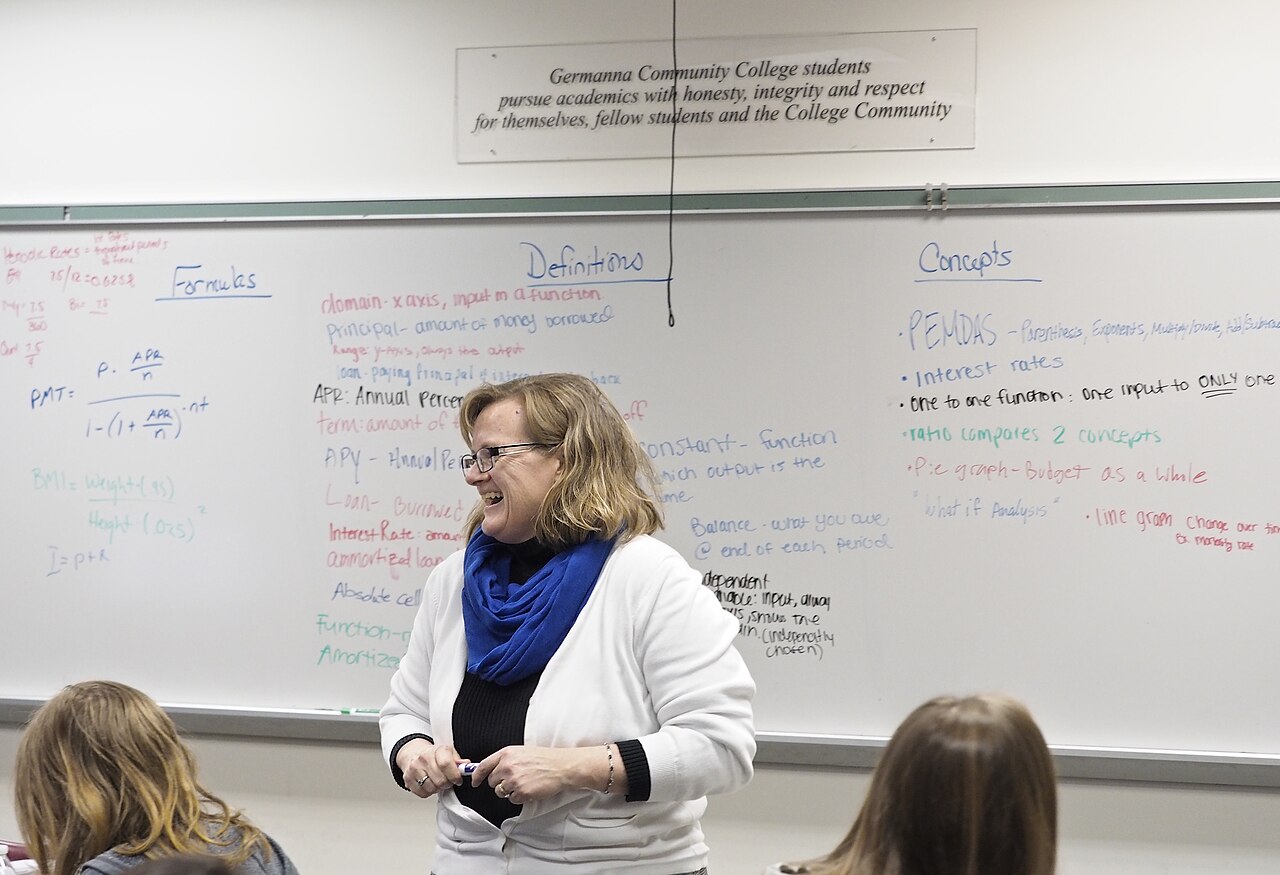
An associate professor teaches a quantitative reasoning math class. Photo: Robert A. Martin / Germanna Community College (Virginia), Jan. 29, 2018, via Wikimedia Commons, CC BY 2.0. Not an ACC classroom.
