Companies with certain city contracts must pay their workers at least Austin’s living wage, now $22.05 an hour. A new City Auditor’s report finds that city staff don’t consistently check whether they do. In a sample, auditors found 15 workers who were paid less. The Council’s Audit and Finance Committee will be briefed on the audit Wednesday, Oct. 21. Members will also consider the auditor’s 2027 audit plan and hear briefings on the city’s redevelopment projects and social services strategy, according to the revised agenda.
The committee meets at 9:30 a.m. at City Hall, 301 W. Second St. Mayor Kirk Watson chairs it. The other members are Council Members Ryan Alter (vice chair), Vanessa Fuentes, José “Chito” Vela and Marc Duchen, with Council Member Krista Laine as alternate. Public comment is allowed in person or by phone on items posted for possible action, but not on briefings. Instructions are on the city’s Council Committee Information Center page, the agenda says.
The living wage audit (Item 8). The city created its Living Wage Program in 2016 to set a minimum wage for workers on certain non-construction city contracts, and launched it in 2019. The program covers competitively bid contracts for services performed on city property or city vehicles that require Council approval, according to the audit report. The copy posted as backup is watermarked “draft.” Auditors reviewed contracts executed in fiscal years 2023 through 2025 and found:
- Missing paperwork. Of 59 sampled contracts, the city had no contractor certification form for nine. Six other forms didn’t list the employees on the job. Contract managers didn’t collect employee certification forms for 46% of the employees listed.
- Underpaid workers. Auditors obtained pay data for workers on 36 contracts. Across four contracts, 15 of 285 employees, or 5%, didn’t receive the living wage. Auditors referred those cases to the city’s Wage Theft team.
- Training gaps. The only living wage training is part of a broader purchasing refresher. Auditors described staff who didn’t know what a contractor certification form was or when to collect forms. One form listed an hourly rate of $11 instead of the correct $21.63.
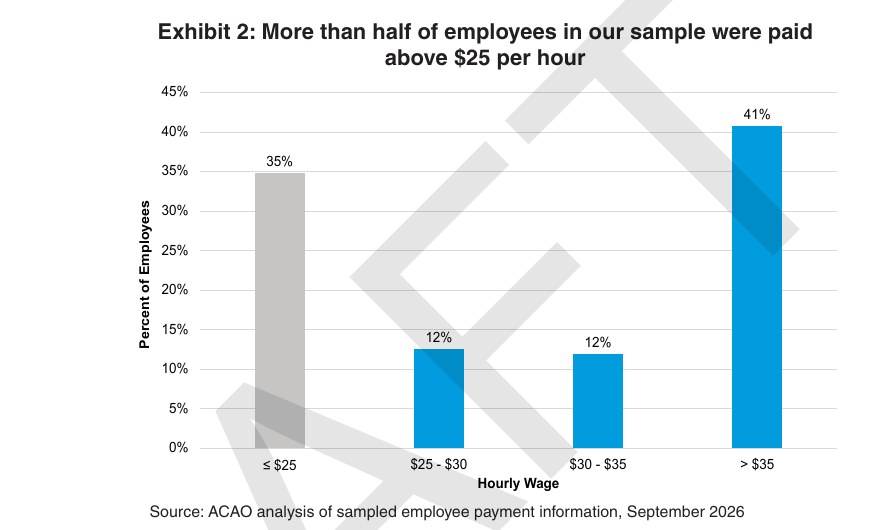
- Effort spent in the wrong place. About 65% of sampled workers with confirmed pay earned more than $25 an hour. Contract managers said monitoring those contracts is unnecessary and inefficient, the report says.
The auditors recommend that the director of Austin Financial Services improve training and guidance for staff who monitor these contracts. Management agreed, while noting that its advanced contract management course and mandatory kickoff meetings already cover the program. Management also said as many as 95% of sampled workers appeared to be paid correctly and that it is investigating the contracts flagged. Its plan includes a new procurement system in fiscal 2027, performance evaluations for all contracts starting in early 2027, and mandatory annual training and certification for contract monitors by late fiscal 2027, according to the report.
The 2027 audit plan (Item 5). The City Auditor’s proposed plan lists 10 new audits:
- governance of artificial intelligence
- office space use
- access to parks
- whether the Office of Police Oversight is providing impartial oversight
- responsiveness to noise complaints
- road resurfacing
- government transparency
- employee compensation
- long-term water availability
- IT controls for critical systems
Audits carried over from 2026 include homelessness coordination, Austin Police field training, EMS billing, end-of-year line-item spending and Austin Water cybersecurity. The auditor’s office is also overseeing a consultant’s three-year efficiency assessment of city departments. Departments that serve residents directly, including public safety, housing, parks, public health and libraries, are first up in 2027, the plan says.
Briefings. Staff will brief members on the city’s redevelopment and public facilities portfolio, including Colony Park, the St. John site, the Northeast Service Center and the Public Safety Headquarters. The presenters are Mandy DeMayo, real estate and asset strategy officer, and Kim Olivares, director of Austin Financial Services. Assistant City Manager Stephanie Hayden-Howard and budget staff will brief members on the city’s social services strategy, the agenda says. Members will also consider bylaw amendments for the Hispanic/Latino Quality of Life Resource Advisory Commission and the Austin Travis County Food Policy Board.