This article is enhanced by Local Insights Pro.
Bike clubs, butterfly greenhouses and a smoothie game.
Austin is spending $175,500 to put bike clubs, rain gardens, compost bins and new trees on 53 campuses through 65 student-centered climate projects.
Austin Climate Action and Resilience announced this year’s Bright Green Future Grants in a Nov. 18 release. Each project gets up to $3,000. The office received 129 applications from 78 schools and picked projects from every City Council district, the release says. More than half of the winning schools qualify for federal Title I money, which goes to schools serving more students from low-income families.
The odds were decent but not easy: 65 of 129 applications got money, and 53 of the 78 schools that applied came away with at least one project. The average award works out to $2,700.
“These awarded projects represent hope, inspiration, and resilience,” said Zach Baumer, the office’s director, in the release. Alli Wren Martin of La Tribu Rural said her school’s philosophy is “all about immersing our students in nature, language, and community,” and that its grant will build El Mariposario, a greenhouse she described as “a living classroom where they can get their hands in the dirt.”
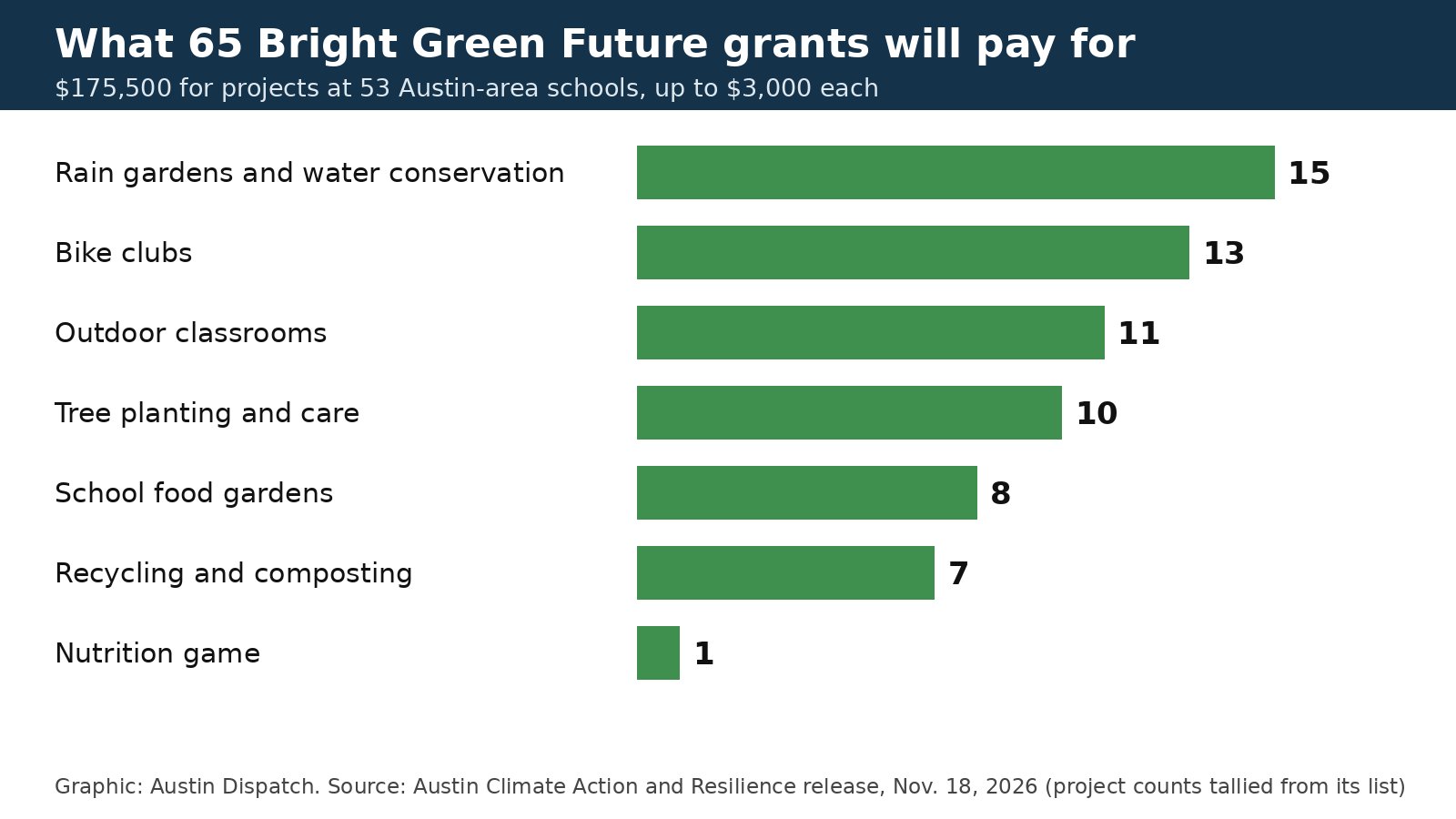
What’s getting built. A Dispatch tally of the city’s list:
- Rain gardens and water conservation, 15 projects: Anderson Mill, Casey, Maplewood, Odom (two), Padron, Perez and Reilly elementaries, plus Summit Christian Academy, The Green Dome (two), City School, Angel’s Care and Learning, Cedar Park High School and Austin Youth River Watch.
- Bike clubs, 13: Blanton, Bluebonnet Trail, Brentwood, Lee Lewis Campbell, Cedar Creek, Govalle, Gullett, Harris, Reilly, Russell Lee and Travis Heights elementaries, plus Kealing and Lamar middle schools.
- Outdoor classrooms, 11: Andrews, Brentwood, Nan Clayton, Creedmoor, Joslin, Menchaca, Newton Collins, Oak Hill, Pillow, River Oaks and St. Elmo elementaries.
- Trees, 10: Galindo, Mathews, Perez, Sanchez, St. Elmo, Travis Heights, Uphaus and Zilker elementaries, the Austin Butterfly Academy and Angels Learning Center.
- Food gardens, 8: Davis, Sanchez and Wells Branch elementaries, Covington Middle School, Austin Achieve High School, Eastside Early College, Austin Micro School and La Tribu Rural.
- Recycling and composting, 7: Blanton, Casey, Maplewood, Pickle and Rodriguez elementaries, Forbes Childhood Development Center and St. Austin Catholic Academy.
- A nutrition game, 1: Foundation Communities’ “The Smoothie Quest.”
The release says winners come from Austin ISD, Pflugerville ISD, Del Valle ISD and private schools. The list also includes Cedar Park High School, a Leander ISD campus, and two nonprofits that aren’t schools, Austin Youth River Watch and Foundation Communities.
Why schools. The program’s pitch is hands-on learning that also does something measurable for the neighborhood, according to the release: outdoor lessons, cleaner runoff, fewer trips to the landfill. Several projects double up, too. Brentwood, Casey, Maplewood, Perez, Reilly, Sanchez, St. Elmo and Travis Heights each landed two different kinds of projects.
Who pays. Five city departments pool money for the program: Climate Action and Resilience and its Urban Forestry team, Austin Resource Recovery, Transportation and Public Works, Austin Water and Watershed Protection. Mayor Kirk Watson’s office plans to chip in this school year, the release says, without naming an amount. The release does not break down how much each department contributes, and it doesn’t list which winning schools are Title I campuses.
The long view. Since the program started in 2012, 112 schools have received grants and the city says the program has touched more than 165,000 students. The release does not explain how that count is calculated when this year’s projects must be finished or when the next round of applications opens. Baumer’s office runs the program, and the release lists Shannon Stewart as its contact.