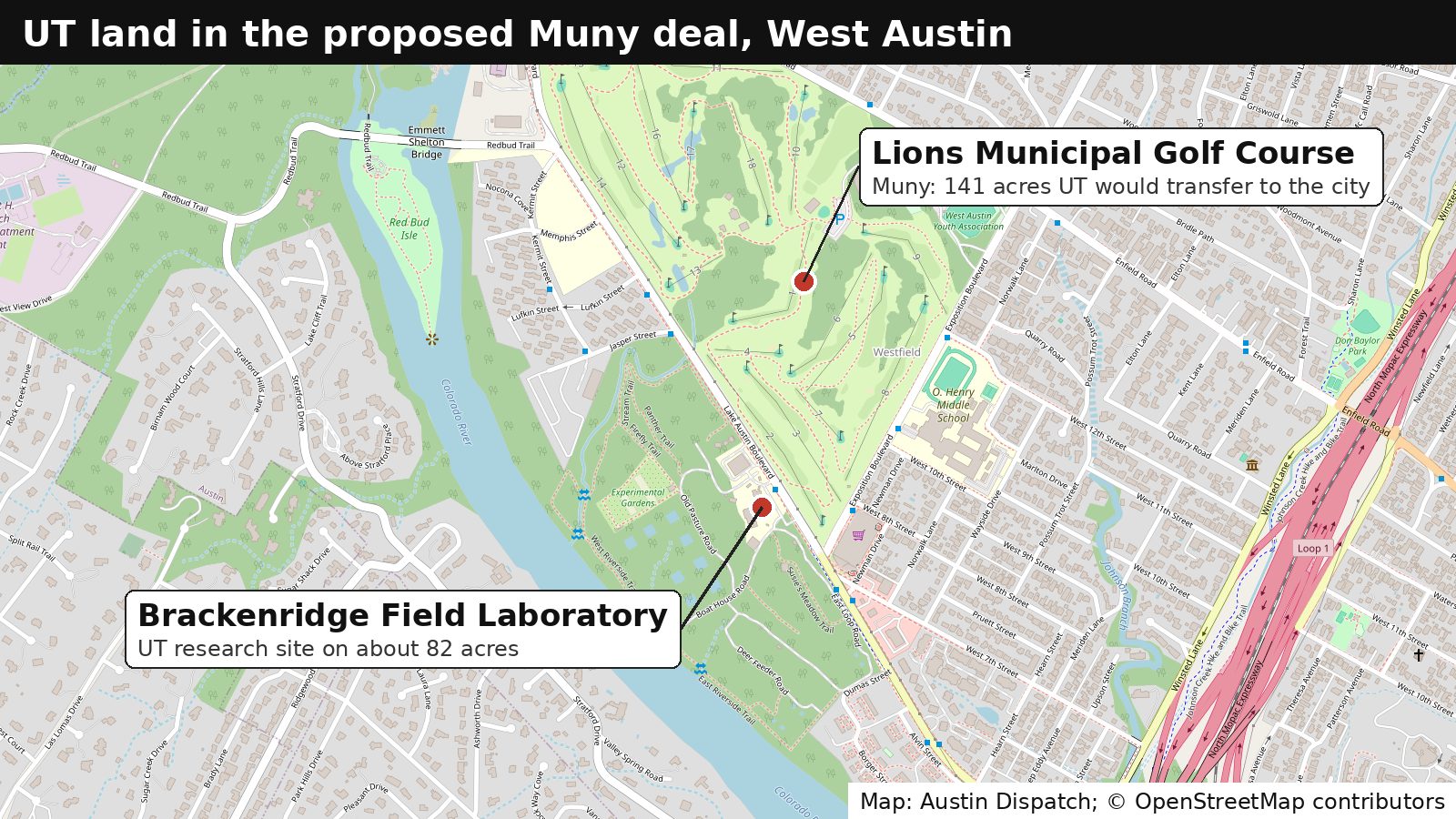
Austin City Council members were briefed Tuesday, Nov. 17, on amending a 1989 development agreement with the University of Texas, ahead of a Council vote scheduled for Dec. 3.
The amendments would give the city permanent ownership of Lions Municipal Golf Course, the 141-acre course known as Muny, according to the city’s briefing slides. In exchange, UT could build up to 4.9 million square feet of non-university development across 190 acres of its Brackenridge land along Lake Austin Boulevard. The 1989 agreement allows 1.7 million square feet.
Council Member Vanessa Fuentes said most speakers supported saving Muny and that the open question in their testimony was the Brackenridge Field Laboratory, a UT research site on about 82 acres of the same land, according to the meeting transcript. City legal staff told the Council that under both the current and the amended agreement, UT decides what happens to the lab when it builds for university purposes.
The agreement also changes who pays for roads and utilities. The 1989 deal puts that on the city; the amendment would let a tax increment reinvestment zone, or TIRZ, cover it. A TIRZ sets aside the growth in property tax revenue inside a district to pay for public improvements there.
“This allows for the site itself to pay for that infrastructure, as opposed to us having to utilize other resources that might impact all of our residents and taxpayers,” said Kimberly Olivares, the city’s director of financial services, according to the transcript.
The field lab question. Richard Suttle, who spoke on behalf of UT, answered Fuentes with a university statement saying UT is relying less on the Brackenridge site as it expands a network of field stations, and that the amendment does not decide the lab’s future, as The Dispatch reported Nov. 11. Council Member Ryan Alter asked whether UT could close and clear the lab today; the answer was yes, for university purposes.
Council Member Zohaib “Zo” Qadri asked Suttle to raise the lab with the private donor whose gift to UT makes the golf course transfer possible. Suttle said the donor’s focus has been the golf course and that he would take the request back. Council Member Marc Duchen gave colleagues a concept map he said shows UT could build nearly 5 million square feet and still keep the lab’s 82 acres.
What two city commissions recommended. Both the Environmental Commission and the Planning Commission asked the Council to delay its vote, staff said; the Planning Commission’s written recommendation is not yet final. The Environmental Commission’s list includes:
- requiring UT to keep all 82 acres of the lab in perpetuity, give the city an option to buy the land if UT closes it, and give five years’ notice before closing or restricting it
- a 300-foot setback from Lady Bird Lake with no impervious cover, instead of the proposed 200 feet with limited impervious cover
- a 70% cap on impervious cover across the 190 acres, instead of the proposed 75%, and a 75-foot height limit
Staff said the Planning Commission also backed a 300-foot buffer around the lab, but proposed heights of at least 200 feet or downtown-style zoning elsewhere on the tract. Mayor Pro Tem José “Chito” Vela, who chaired the afternoon, said trading higher entitlements for protecting the lab appeared to offer a path forward.
Traffic. Lake Austin Boulevard carries about 15,000 trips a day and could handle about 25,000 without major improvements, an assistant director of the city’s transportation department said. Full buildout could generate up to 30,000 to 33,000 trips a day, he said.
What the slides say, and what staff could not yet say. The slides state that the TIRZ “allows UT development on the site to pay for infrastructure.” Staff told the Council there is no current cost estimate for that infrastructure, that the last figures were about a year and a half old and based on a larger development, and that the total would likely run to tens of millions of dollars. If a TIRZ were challenged and struck down, staff said, the city could be looking at voter-approved bonds.
The term sheet says the TIRZ would follow the city’s TIRZ affordable housing policy “but not requiring the affordable housing within the TIRZ area.” Staff said that policy calls for 20% of units to be affordable, on site or on other UT property.
What’s unresolved. The briefing documents do not list the cost of the infrastructure the TIRZ would cover, and Suttle said the amount of the donor’s gift is not public. Which city rights-of-way near campus would be vacated depends on appraisals and more detail from UT, staff said. Council Member Mike Siegel asked whether voting before the financing plan gives up leverage; staff said it does not, because the 1989 agreement already obligates the city to pay for infrastructure.
What happens next. Council action is scheduled for Dec. 3, according to the slides, and the UT Board of Regents is tentatively set to act in December. A second package in 2027 would bring the TIRZ financing plan, a regulating plan, the right-of-way vacations, changes to UT’s lease at Mueller and the transfer of Muny to the city. Council meetings are held at City Hall, 301 W. Second St.; the Dec. 3 agenda had not been posted as of Nov. 19. Speaker registration and streaming details are on the Council Meeting Information Center.