This article is enhanced by Local Insights Pro.
Austin Energy customers could see the city’s electric utility open a review of its rates next year, after the utility ended its 2026 budget year short of all five financial health targets it reports to the City Council.
Austin Energy General Manager Stuart Reilly told the Council’s Austin Energy Utility Oversight Committee on Tuesday, Nov. 17, that the utility’s financial policies call for a cost-of-service review every five years and that the cycle comes up for fiscal 2026, according to the meeting transcript. Audited financials arrive in late March or early April, he said, and staff will come back early next year to talk with the Council about what a rate review could look like. Council Member Mike Siegel, the committee’s vice chair, had asked for a future discussion of the pros and cons of a 2027 rate case.
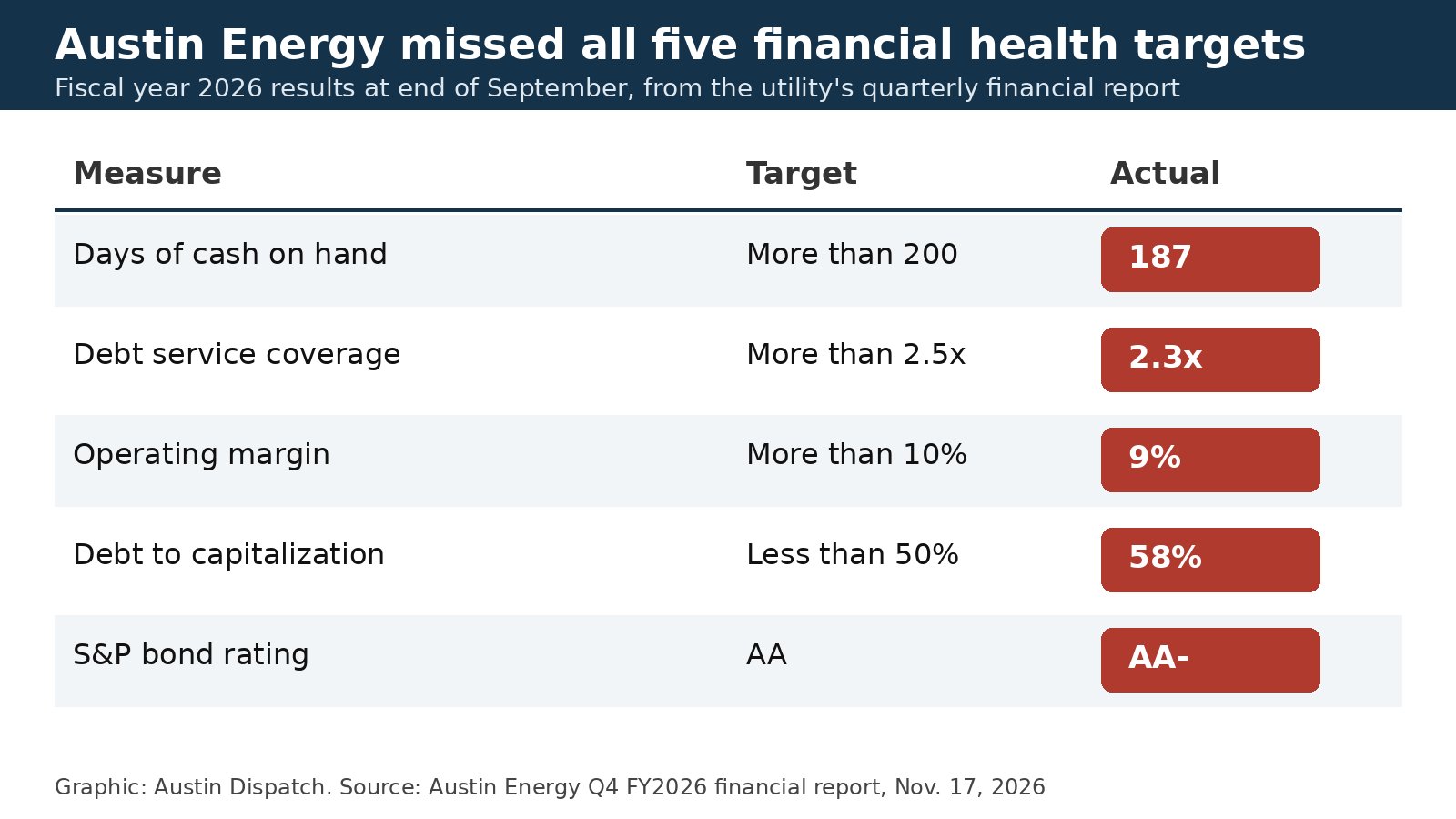
The scorecard. The utility’s fourth-quarter financial report lists these results at the end of September, against the targets set in its financial policies:
- 187 days of cash on hand, against a target of more than 200, down from 195 days at the start of the fiscal year
- debt service coverage of 2.3 times, against a target above 2.5
- an operating margin of 9%, against a target above 10%
- debt equal to 58% of capitalization, against a target below 50%
- an AA- bond rating from S&P Global, one step below the AA target
The same report’s summary describes the utility as in “substantial compliance” with its financial policies as of September. Costs exceeded revenues by $8 million for the year, compared with a budgeted shortfall of $43 million. Chief Financial Officer Stephanie Koudelka told the committee that revenues need to keep up with costs to meet the targets and keep borrowing costs low, according to the transcript.
How Austin bills compare. Koudelka’s slides, citing U.S. Energy Information Administration data for 2025, put Austin Energy’s average residential bill at $109.74 a month, compared with an average of $178.21 for ERCOT-area providers with more than 3% residential load. Austin Energy’s average residential rate was 13.14 cents per kilowatt-hour, compared with 15.76 cents for that group.
New state rules. Reilly said three laws passed in the 2025 legislative session add filings with the Public Utility Commission of Texas: utility pole integrity standards, a distribution pole management plan and a wildfire mitigation plan. The pole standards are slated for the Council’s Jan. 28 agenda, according to his slides. He said the wildfire plan must go through a contested case, a trial-like hearing at the commission, and that the work could bring budget impacts or new staff.
Batteries and peakers. Deputy General Manager Lisa Martin said that as of Nov. 15 there were about 215 customer installations under the utility’s wholesale agreement with Base Power, totaling 4.3 megawatts toward the 40 megawatts the contract calls for within 18 months. Her operations report puts the contract at about $4 million a year for 10 years. The report also shows the Decker gas peaker units at 92.5% commercial availability this summer, a measure of how often a unit is ready when the market needs it, below a 95% target. Martin told the committee those units are not providing the reliability customers need.
Council Member Marc Duchen said some Base customers have reported a promised feature that would let the batteries send power back to the grid has been delayed for about four months. Reilly said the commitments Base makes to customers are its own, and offered to connect Duchen’s office with a contact at the company.
The committee’s next meeting is set for 9 a.m. Jan. 26, 2027, under the 2027 schedule it approved Tuesday. Reilly said the rate discussion may not come first thing in 2027 because the same teams face the new state filings, a transmission rate case and the budget. Any change to rates would require a Council vote.