This article is enhanced by Local Insights Pro.
In 2025, landlords filed more cases in Travis County’s justice courts than in either of the two years before. Now state law moves evictions along faster. And since this spring, Austin renters who fall behind have had no city application for emergency rent help. The I Belong in Austin portal is “closed indefinitely.”
On Thursday, Oct. 22, Austin City Council will vote on what is left of the program. Item 22 would add $2.25 million to the city’s contract with El Buen Samaritano Episcopal Mission, which runs I Belong in Austin. The contract’s total would rise to $24.05 million. The money comes from Austin Housing’s fiscal 2026-27 operating budget. City staff say it is meant “to avoid a gap in service,” as Council ordered in August.
Put that money next to the number of cases in court, and the gap is plain. The item is on the consent agenda, so it could pass without discussion.
The filings
The Texas Office of Court Administration publishes monthly landlord-tenant caseloads for every justice court. Its data show new cases filed in Travis County’s five justice of the peace precincts:
- 2023: 10,451
- 2024: 12,727
- 2025: 14,262, up 12% from 2024 and 36% from 2023
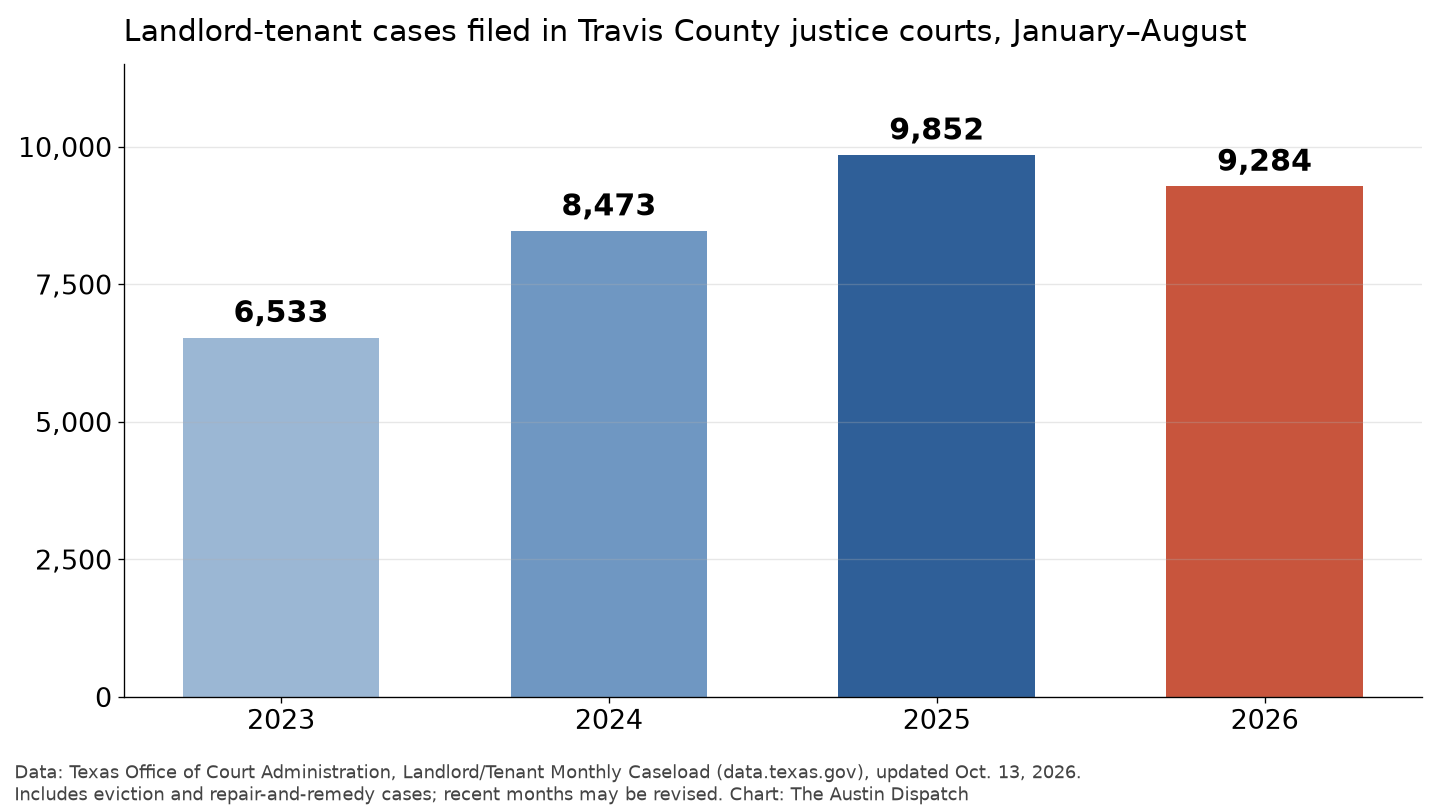
- January through August 2026: 9,284. That is down about 6% from the same months of 2025 (9,852), but up about 10% from 2024 (8,473) and 42% from 2023 (6,533).
Those state figures cover the whole county, not only Austin. They include repair-and-remedy cases along with evictions. The most recent months can still change as courts report.
Council’s own count is higher. In Resolution No. 20260827-069, adopted Aug. 27, Council said eviction filings rose 14% from 2024 to 2025, to 15,092. It called that a record for evictions filed in Austin in one year. It also said about 1 in every 20 renter households was affected by an eviction filing. The resolution doesn’t name its data source, and The Dispatch could not match its total to the state data. Either way, both sources show the same direction: filings in 2025 were well above the two years before.
Faster evictions under state law
Senate Bill 38, by Sen. , R-Houston, rewrote much of the state’s eviction process. Most of it took effect Jan. 1, 2026. According to the Legislature’s bill summary and the Senate Research Center’s analysis, the law:
- requires a sworn petition to start an eviction case
- allows summary disposition, a ruling without a trial, in some cases
- limits trial postponements to seven days unless both sides agree in writing
- lets landlords use other law enforcement officers if a constable hasn’t served papers or carried out a writ within set deadlines
- sets a five-day window to appeal
- requires tenants to pay rent into the court registry during any appeal
- says only the Legislature can modify or suspend these eviction procedures, with a narrow exception for the Texas Supreme Court during disasters
The bill’s statement of intent frames it around squatting and nonpayment cases. It says that when there is no genuine dispute over the owner’s right to the property, getting it back “should be straightforward and efficient.” Council’s August resolution described the same law as having “reduced renter protections in eviction processes,” with tighter timelines and changes to notices and appeals.
What happened to I Belong in Austin
The city announced the shift on Feb. 27. Its news release said the fiscal 2026 budget Council adopted last fall reduced the program’s overall funding from $4 million to $3 million. The rent-help application portal would close indefinitely, and the remaining money would go to negotiated eviction settlements handled by the city’s legal partners. The release also said those legal partners “are currently at capacity amid continued demand.”
“Refocusing I Belong in Austin resources on eviction settlement allows us to target immediate threats of displacement,” Austin Housing Director Deletta Dean said in the release.
Nefertitti Jackmon, Austin Housing’s community displacement prevention officer, said in the same release: “We hope this approach will lessen the burden and expectations of thousands of households applying for rent assistance each month who are ultimately denied because the resources cannot meet the increasing demand for financial assistance.”
The release said the final application period would be March 1-7. The city’s rental assistance page now says the final period was April 1-7 and that the portal “will not reopen on May 1, 2026.”
The program had been reaching a few hundred households a year through applications: 725 in fiscal 2025, and 139 from October 2025 through February 2026, according to the release. From June 2021 through February 2026, the city says, I Belong in Austin:
- distributed more than $16 million to more than 3,100 households facing eviction
- gave 2,562 households direct rental assistance
- helped 744 households through negotiated settlements
- reached more than 9,000 people, including 4,646 children
The ZIP codes it served most were 78753, 78741, 78744, 78723 and 78758, all in North, East and Southeast Austin.
What the $2.25 million would and wouldn’t do
According to the agenda backup, the amendment would provide $2.25 million in rental assistance funding for current displacement-prevention services. Staff based the amount on “historical spending and anticipated demand.” The contract started in July 2023, and Council last added $4 million in October 2025.
The backup does not say whether any of the money would reopen the application portal or simply continue the settlement-only approach. Either way, it is less than the program had before. City figures show it at $3.6 million in fiscal 2025 and $3 million in fiscal 2026, after the cut. In August, Council’s resolution said that, aside from this $2.25 million, the new fiscal 2026-27 budget “does not identify funding for any existing displacement prevention programs.”
That resolution, sponsored by Council Member Zohaib “Zo” Qadri and co-sponsored by Council members , Ryan Alter, Vanessa Fuentes and Natasha Harper-Madison, according to the Aug. 27 agenda, directed the city manager to:
- Grade the programs. Evaluate how well the city’s displacement- and homelessness-prevention programs work across departments.
- Find money for what’s working. Prioritize available money in the fiscal 2026-27 Housing Trust Fund and the housing department’s capital budget for current services, including legal help and navigation, “ensuring no gap in well-performing displacement prevention services.”
- Bid out anything new. Hold a competitive solicitation for any new services.
- Report back. Present progress to a Council committee by Feb. 1, 2027.
A second item on the same agenda adds a little to the support network. Item 7 would approve up to $864,210 over 10 years so the Waverly North affordable housing development, at 3710 Cedar St., can give no-cost office space to Housing Support Services Alliance, a nonprofit that provides eviction-prevention services.
Why it matters
Each household pushed out is a family that may leave its neighborhood, change schools or turn to the homelessness system. Council made the cost argument itself in August, calling rental assistance, eviction prevention and diversion “evidence-based methods” that reduce “the stress on the homelessness response system.”
The math is hard to escape. Travis County justice courts saw more than 14,000 landlord-tenant filings last year. The city’s application program reached 725 households in its last full year, and now the application portal is closed. A $2.25 million contract top-up keeps the lights on, but it does not answer Council’s own question about how Austin will prevent displacement at the scale it is happening. That answer is due in February.
Housing help is also under pressure at the county. Our preview of the Travis County Commissioners Court briefing covers voucher funding risks and a $15 million loan fund.
What to watch
- Oct. 22: Council convenes at 10 a.m. at City Hall, 301 W. Second St. Items 7 and 22 are on consent. Public comment is allowed in person or by phone. Instructions are at the Council Meeting Information Center.
- Feb. 1, 2027: Deadline for the city manager to present the displacement-prevention evaluation and recommendations to a Council committee.
- Monthly court data: The state’s caseload data will show whether this year’s slight dip below 2025 holds.
Renters looking for current options can check the city’s rental assistance page for updates.
Featured image: Chart by The Austin Dispatch showing landlord-tenant cases filed in Travis County justice courts from January through August of each year, 2023-2026. Data: Texas Office of Court Administration, Landlord/Tenant Monthly Caseload, via data.texas.gov, updated Oct. 13, 2026.