This article is enhanced by Local Insights Pro.
Austin’s transportation department put out a report this month with a clear verdict: the speed cushions, mini-roundabouts, pedestrian islands and lower speed limits it has installed since 2020 are slowing drivers down and cutting the worst crashes. The catch is on a different city web page. The program that builds those projects says it has spent everything it has, and it’s not picking new streets until more money shows up.
The report, “Speed Management in Austin,” dated October 2026 and published by Austin Transportation and Public Works, says the city’s speed work is associated with yearly reductions of 17% to 39% in crashes that kill or seriously injure someone, depending on the strategy. It puts the drop in yearly comprehensive crash costs on the treated roads at as much as $160.4 million. Axios Austin reported on the findings Monday.
On Sept. 24, the department posted this update on its Speed Management program page: “All available funds for the program have been appropriated.” The department says it will collect one last round of traffic data on streets residents asked about this year, but “future data collection and project selection for the program is currently on hold until additional funds are made available.”
So the city has strong evidence that something works and no new projects in the pipeline. For Austinites asking the city to slow down traffic on their block, that’s the story.
What the report found
The report looks at three strategies: lower speed limits on major roads, physical traffic calming on neighborhood and collector streets, and the 25 mph default limit the City Council set in 2020 for about 800 miles of residential streets.
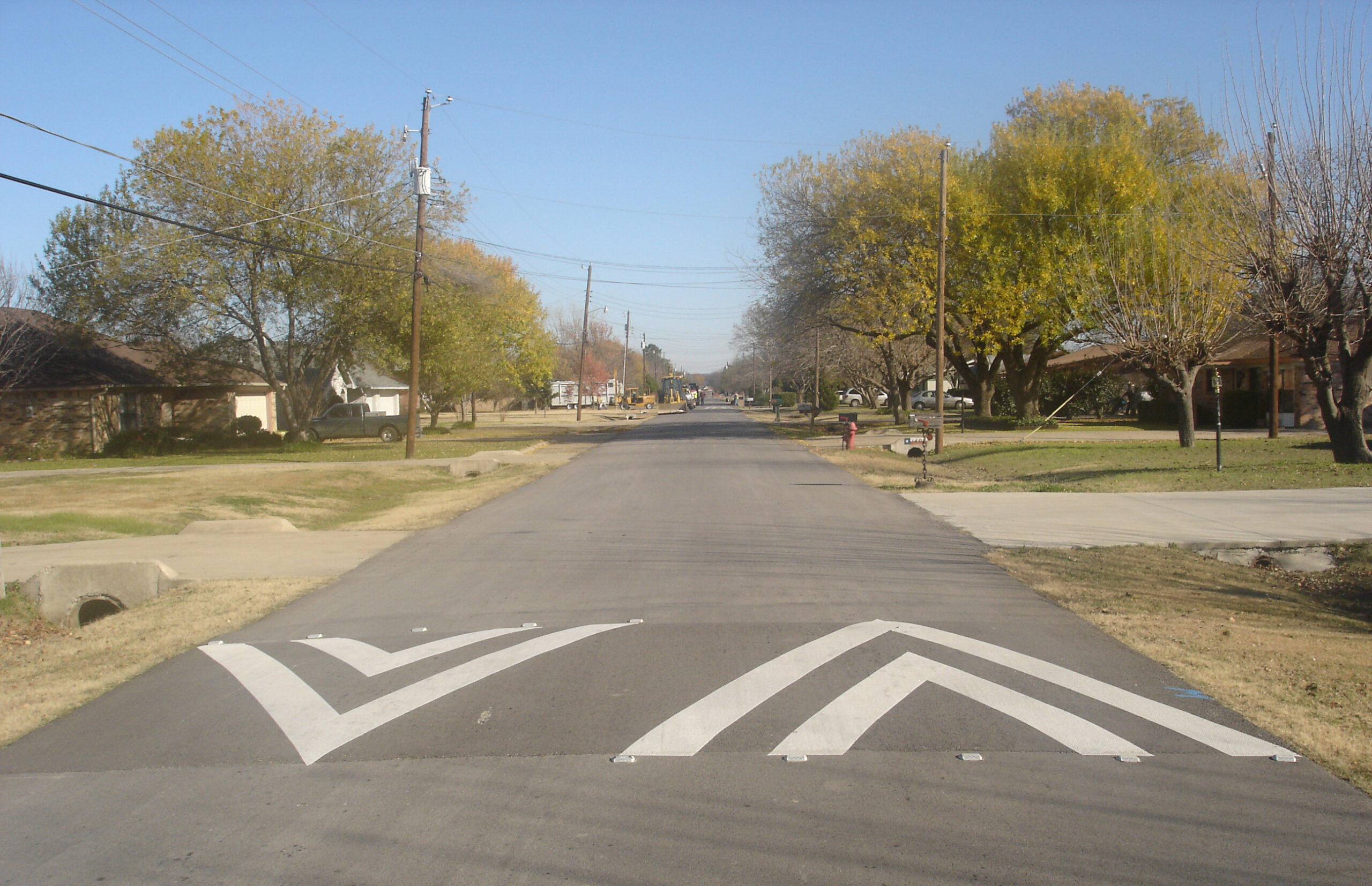
Physical traffic calming had the biggest effect by far. Staff studied 25 projects finished after 2020. At 48 measuring points, the speed that 85% of drivers stay under fell by 5.9 mph. The number of vehicles going at least 10 mph over the limit fell 78%, which works out to 5,300 fewer of those drivers. Projects that used speed cushions cut that kind of speeding by 89%, compared with 65% for projects that used other tools, according to the report.
Looking at crashes, the report covers 29 traffic calming projects spanning 18.6 miles. Fatal and serious-injury crashes on those streets fell 33.4%, compared with 22% on similar streets citywide, when the report compares 2016–2020 with 2021–2025. The city estimates traffic calming returns $2.80 a year in avoided crash costs for every $1 spent.
Lower speed limits on their own did less. Council lowered limits by 5 to 15 mph on 73 segments of high-speed arterial roads in 2020 and 2022, covering about 100 miles, according to the report. On those roads, the speed most drivers stay under fell an average of 1.7 mph at 186 measuring points. Fatal and serious-injury crashes on those corridors fell 17%. Comprehensive crash costs fell 23%, or $106.2 million a year.
On residential streets with the 25 mph limit, the report says fatal and serious-injury crashes fell 38.7% when comparing 2016–2020 with 2021–2025. That’s the biggest drop of any street type. The speed data there is murkier. Streets with new 25 mph signs and comparison streets without them both slowed down, and the city’s two data sources disagreed on how much the signs added.
The report is upfront about its limits. It says it “identifies strong associations” between the speed work and safer streets “but does not establish direct causation.” Many corridors got several safety upgrades at once, and the pandemic-era jump in reckless driving makes before-and-after comparisons harder. The report also says the strongest and longest-lasting results come from changing the street itself, not from posting a new number on a sign.
Why the money matters
Austin pays for traffic calming mostly with voter-approved bonds. The city auditor flagged that as a weak spot in a January 2026 audit of the city’s speed reduction work. The audit found that most projects lowered speeds and that Austin picks locations more proactively than most peer cities. It also said “Austin is unique among peer cities in funding traffic projects primarily using bonds” and “it is unclear how the City will continue to fund traffic calming projects in future years if new bond funds are not available.” The audit noted that Fort Worth and Arlington pay for this work from operating budgets, while Dallas, Houston and San Antonio use council district funds.
The auditor also found that many of the city’s traffic calming devices were installed in the 1990s, have a 20- to 25-year lifespan, and are at or near the end of it. The audit said the program had no maintenance plan for asphalt speed cushions.
New bond money isn’t close. City financial staff recommended putting off a comprehensive bond election until 2028, Austin Current reported. Council instead put a $295 million bond package on the Nov. 3 ballot that covers only parks and libraries. Proposition A is $260 million for parks and Proposition B is $35 million for libraries. Neither one pays for transportation. On Oct. 8, Council directed staff to plan the next comprehensive bond elections, which would include transportation, for fiscal years 2028 and 2034, Community Impact reported.
Council did set aside some money. During the Aug. 12 budget adoption, Council Member moved to add $1 million to the transportation department’s capital budget for speed bumps and other traffic calming, paid for with one-time certificates of obligation or another appropriate source. The amendment passed without objection, according to the official meeting transcript and Alter’s motion sheet, which says the department “has an extensive backlog” of these projects. The program page was updated six weeks later and still says the program is on hold. The department hasn’t said publicly how the $1 million fits into that.
The size of the program is worth keeping in mind. By the department’s own methodology, it studies up to 240 streets a year, half requested by residents and half flagged by crash and street-width data. From those, it picks about five to 15 streets a year for projects, depending on funding.
What residents are hearing now
Residents are already hearing about the pause. A 311 request about a speeding driver on the 200 block of Waller Street was closed Sept. 14. The city’s note on it says the street isn’t enrolled in the program, that the program “is currently on hold until additional funding is available,” and that the resident should report speeding to the Austin Police Department.
That’s a thin backup plan. The auditor said APD has “limited traffic enforcement capacity,” and the speed management report notes that Texas law limits tools other cities use, like automated speed enforcement. The program page now points residents to yard signs, temporary speed display boards they can request through 311, and asking police to watch their street.
Why it matters
Austin keeps adding people and cars faster than it fixes the streets they use. Here, the city’s own analysis shows a cheap, proven fix that pays for itself several times over. The holdup is a funding model that depends on a bond cycle that won’t bring new transportation money until 2028 at the earliest.
The stakes aren’t abstract. Axios, citing city data, reported that 60 people have died in crashes in Austin so far this year, down from 79 at this point last year. The report credits recent progress, including a 27% drop in serious-injury crashes from 2024 to 2025, and says the city “will continue to employ speed management strategies.” It doesn’t say what will pay for them.
Some questions Council and the transportation department should answer in public: Where did the $1 million from August go, and how many streets will it cover? Will the city follow the auditor’s suggestion and fund traffic calming from the operating budget or council district funds, the way other Texas cities do? And what’s the maintenance plan for 1990s-era speed humps that are wearing out?
To ask about a street, residents can still file a request through Austin 3-1-1. The full report is on the city’s SpeakUp Austin site.