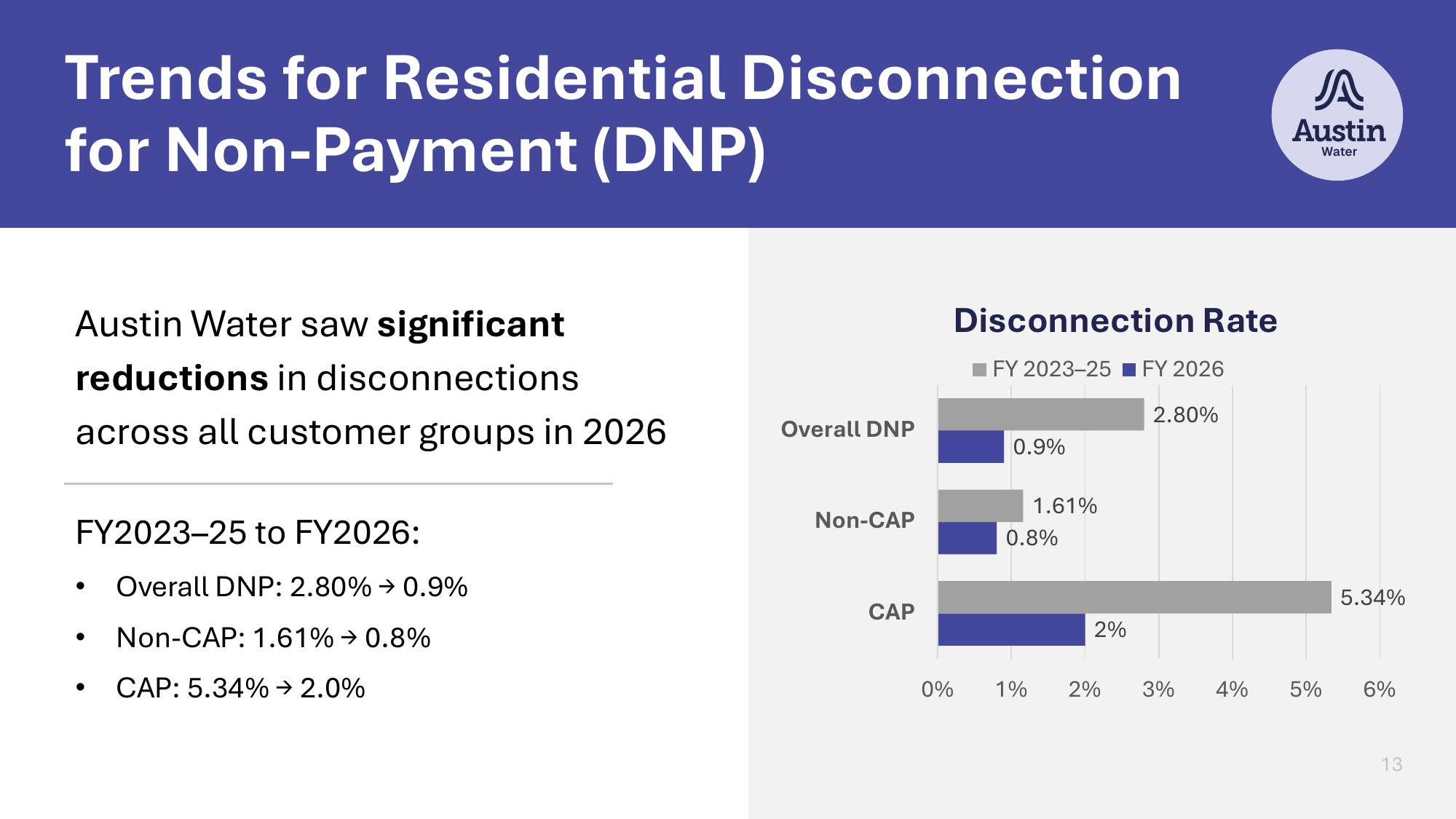
Fewer Austin households lost water service over unpaid bills this year, according to figures city utility staff gave the Water and Wastewater Commission on Oct. 14. Residential disconnections for nonpayment fell to 0.9% in fiscal 2026, down from 2.8% over fiscal 2023–25. The drop was steepest among customers in the city’s discount program for low-income households. Commissioners also heard Austin Water’s first public outline of new rules for the biggest water users. They sent the City Council a long list of water contracts without discussion, including an $89.7 million safety overhaul at the Ullrich Water Treatment Plant.
Shutoffs down across the board. The figures come from a joint Austin Water and Austin Energy presentation by Sandra Escobedo, Austin Energy’s vice president of customer account management, and Matthew Thomas, Austin Water’s assistant director of customer experience. Comparing fiscal 2026 with the average for fiscal 2023–25, the slides show:
- All residential customers: 2.80% disconnected for nonpayment, down to 0.9%.
- Customer Assistance Program (CAP) households: 5.34%, down to 2.0%.
- Customers not in CAP: 1.61%, down to 0.8%.
CAP now reaches more than 23,000 residential customers and more than 36,000 multifamily households, with an average bill discount of 53%, according to the presentation. Renters in multifamily buildings get a $17 monthly credit instead of the discount. Staff told commissioners that credit amount hasn’t changed in several years and could be reviewed in a future budget or cost-of-service process, according to the meeting video. Staff said most enrollees are signed up automatically through state benefit programs. They said electric service is generally disconnected before water, with a grace period before water is shut off, and that weather moratoriums pause disconnections.
The slides also cite a new leak-repair program for CAP customers. Since it launched in December 2025, it has fixed long-running private-side leaks for 32 households at an average of about $860 per repair, and the city opened a request for proposals for more repair services on Oct. 12. A slide quoting outside reporting says nearly 24% of Texas residential electricity customers were cut off for nonpayment in 2024, compared with 5.5% of homes served by Austin Energy.
Rules for “high impact” water users. Austin Water staff also briefed the commission on the work the Council ordered in a July 23 resolution on large-volume water customers. Marisa Flores Gonzalez, a water resources team supervisor, and Emlea Chanslor, Austin Water’s chief of staff, described the draft framework shown at a recent public open house:
- Threshold. A “high impact water user” would be a commercial, industrial or manufacturing site that uses, or is projected to use, more than 85 million gallons a year, counting both drinking water and non-drinking water, according to the open house boards.
- New requirements. Those sites would go through a separate application pathway, starting at the service extension request stage. They would also file water conservation plans with five- and 10-year goals, have a water budget with higher rates for use above it, and report annually on water use, wastewater and cooling discharge.
- Enforcement. Plans that fall short of Austin Water’s standards would need Council approval, and the utility could require corrective action plans or impose excess-use charges, staff said, according to the video.
- Campuses. Staff said they intend to add up water use across all the buildings on a campus or phased site plan, so a large user can’t avoid the threshold by splitting facilities.
Answering questions from Commissioner Evan Wolstencroft, who was absent and had sent them in by email, staff said the 85 million-gallon line is similar to thresholds used in Phoenix and Tucson. About 30 people and nine media outlets attended the open house, and 11 paper surveys were returned, staff said. The online survey is open through midnight Sunday, Oct. 18.
Contracts headed to Council. With no discussion and no recusals, commissioners unanimously recommended every contract, service request and bond item on the agenda, Items 2 through 16. Several are on the Council’s Oct. 22 final agenda:
- Ullrich Water Treatment Plant (Council Item 21): an $89.7 million construction contract with MGC Contractors, including contingency, to convert the plant to an inherently safer disinfection process, according to the backup.
- Castle Ridge Road (Item 37): a service extension request for wastewater service to 1107 Castle Ridge Road in the Drinking Water Protection Zone.
- Hexagon asset-management software (Item 19) and the 2026 Reservoir Improvement Program (Item 20).
- Municipal utility district bonds (Items 13–18) for Moore’s Crossing and Pilot Knob districts, plus wholesale wastewater service for the Comanche Canyon Ranch development.
Public speaker comments included concerns about damage to the Festival Beach Food Forest from Interstate 35 utility relocation work. Commissioners asked for an I-35 program update at a future meeting.
What’s next. The Council takes up the Ullrich, Castle Ridge and bond items Oct. 22. Austin Water will bring its large-user recommendations to the Council’s Climate, Water, Environment and Parks Committee on Dec. 9, staff said.