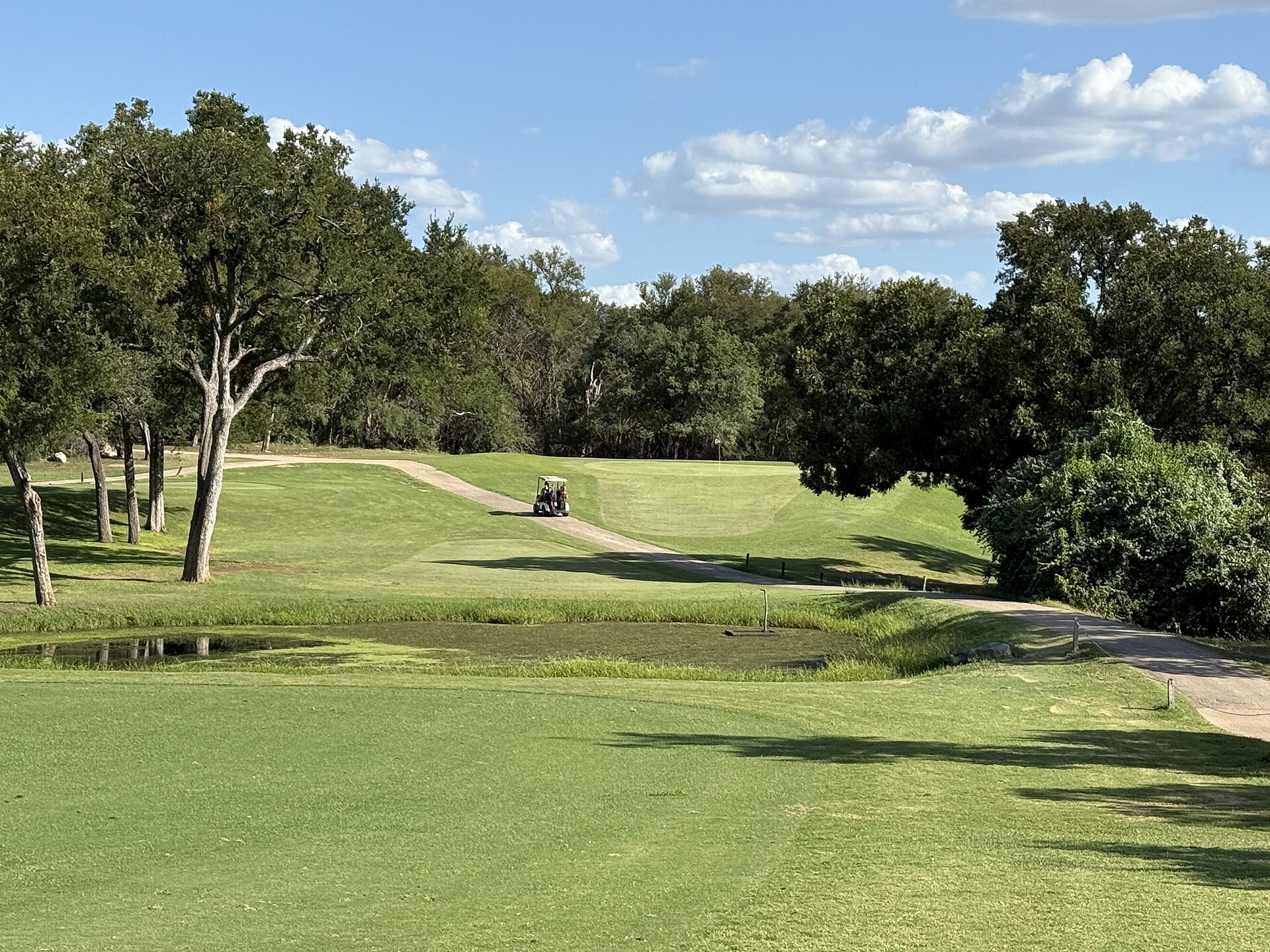
After more than 50 years of efforts to protect Lions Municipal Golf Course, the city and the University of Texas have proposed a deal that would hand the city full ownership of the course, known as Muny. In exchange, the city would set new development rules for about 190 acres of surrounding UT land along Lake Austin Boulevard and Lady Bird Lake. City staff will brief the Environmental Commission on the proposal Wednesday, Oct. 21, ahead of a City Council vote planned for Nov. 19, according to a memo from City Manager T.C. Broadnax.
The commission meets at 6 p.m. in Room 1405 of the Permitting and Development Center, 6310 Wilhelmina Delco Drive. The meeting streams on ATXN. Remote speakers must register by noon the day before with Nicole Corona at 737-291-3084 or Nicole.Corona@austintexas.gov, according to the revised agenda. The Muny item is a staff briefing, so the commission isn’t scheduled to vote on it.
Background. UT owns the land under Muny, which first opened in 1924 and covers about 141 acres. The city has run the course since the late 1930s, and on a month-to-month lease with UT since 2019, Broadnax wrote. In 1950, Muny became the first public golf course in the South to integrate. It is listed on the National Register of Historic Places, and the city says it is Austin’s most-used course, with more than 75,000 rounds a year. The two sides signed the Brackenridge Development Agreement in 1989 to govern how UT can develop its land there. They have amended it several times without settling Muny’s future, the memo says.
What the deal would do. According to a staff summary of proposed amendments, the city would:
- receive Muny
- vacate certain city rights-of-way if feasible, with UT covering utility relocation costs
- amend UT’s lease at Mueller to adjust timelines and allow housing, child care and other uses
- create a tax increment reinvestment zone and a local government corporation for non-university projects in the tract
- adopt a regulating plan that mirrors the amended agreement
UT would agree to replace existing affordable student housing on university property, though not necessarily within the Brackenridge area, the summary says.
How the development rules would change. The summary compares current and proposed standards for non-university projects on the 190.26 acres:
- Floor area: The overall floor-to-area ratio would rise from about 0.4–0.45 to 0.6. Individual sites could go up to 5:1 without a rezoning.
- Height: Buildings would be capped at 65 feet next to and north of Lake Austin Boulevard, and at 105 feet elsewhere south of the boulevard. Both caps allow the code’s existing height-limit exceptions.
- Density: The current limit of 22 multifamily units per acre would be removed.
- Cover: Impervious cover would stay at 75% across the whole area, up to 85% on individual sites, and transferable between sites. Maximum building coverage per site would rise from 50% to 75%.
- Lake setback: The current 200-foot total setback from Lady Bird Lake would stay, split into 150-foot primary and 50-foot secondary zones.
- Environment: The parties would assess critical environmental features south of the boulevard, excluding man-made ones, and then decide whether buffers are needed. On trees, they would reach a compromise between city rules and UT’s heritage-tree policy. Drainage and water quality would follow city code.
Broadnax’s memo summarizes the parameters as a 65-foot height cap as seen from Lake Austin Boulevard, 75% impervious cover sitewide and a 200-foot setback from the lake. Staff will also brief the Planning Commission before the end of October. If the Council approves the amended agreement, a detailed regulating plan would go through boards and commissions and back to the Council in spring 2027, according to the memo. The briefing will be presented by Trish Link of the City Attorney’s Office and Kim Olivares, director of Austin Financial Services, the agenda says.
Also on the agenda. Commissioners will consider recommending that the Council reaffirm its commitment to the Green Infrastructure Initiative, which aims to put more street trees in public rights-of-way. The item is sponsored by Chair Mariana Krueger and Commissioner David Sullivan. The draft recommendation, drafted on Congress for the New Urbanism Central Texas Chapter letterhead, asks the city manager to provide leadership, resources and interdepartmental support for the effort. Staff will also brief members on a sustainable building materials forum on Nov. 13 and a deconstruction workshop Nov. 16–20.