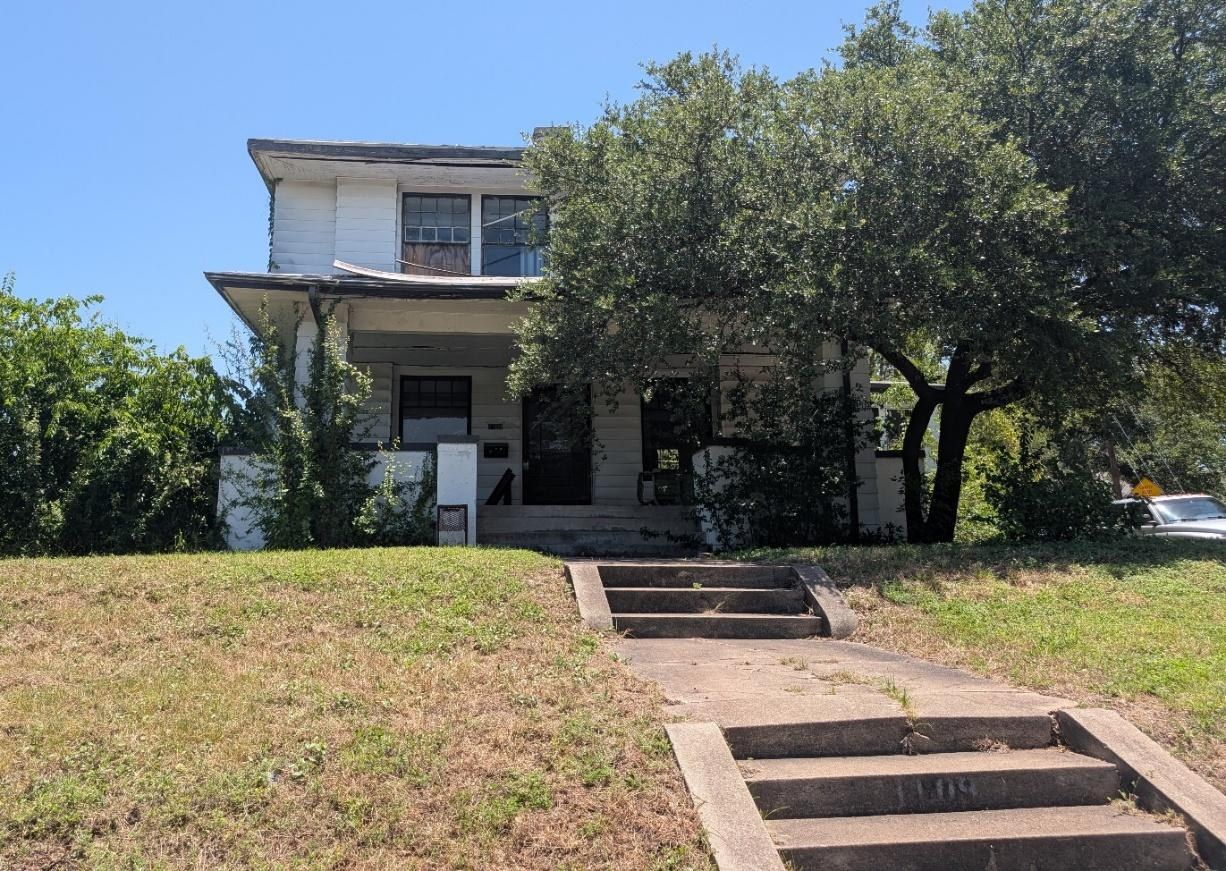
The city’s Historic Landmark Commission can slow or stop the demolition of older buildings, and on Oct. 7 it used that power on two fronts: It recommended historic zoning for a century-old Travis Heights house against the wishes of the applicant and city staff, and it postponed a decision on tearing down the mid-century former Austin Diagnostic Clinic buildings on West 34th Street.
1109 Travis Heights Blvd. The commission voted unanimously to recommend historic zoning for the two-story house at 1109 Travis Heights Blvd., a contributing building in the Travis Heights-Fairview Park National Register Historic District, according to the meeting video. The vote had to be unanimous to meet the supermajority required to recommend historic zoning over the owner’s objection, the presiding commissioner said before the vote. The commission had started the zoning case on Sept. 2.
The staff report describes the house as an American Foursquare with Prairie School influences, lists its construction date as 1918 and attributes it to architect Roy L. Moore. Staff recommended against historic zoning. The report says other Moore buildings that keep more of their original character, including the Herbert and Alice Bohn House and the Stephen F. Austin Hotel, are already city landmarks, and that the house’s ties to developer William T. Caswell and to Elmer and Cora Young do not meet the standard for historical associations.
Gabe Joseph of Joseph Design Build, listed as the applicant in the staff report, spoke against designation, according to the meeting transcript. He said the house has significant problems with its heating and cooling, electrical and plumbing systems, as well as mold, and that restoring it would not make economic sense. He showed commissioners the design of a proposed replacement house and asked them to rely on staff’s research. Neighbors who spoke in favor of designation presented additional research on the people who built and lived in the house, and described it as the gateway to the neighborhood.
Commissioner August Harris III made the motion, thanking neighbors for the added research, and the motion cited the house’s architecture, historical associations and community value. In discussion, a commissioner said Prairie School design this early is rare in Austin and that the house’s prominence at the start of the neighborhood adds to its value as a landmark.
800 and 801 W. 34th St. The commission voted unanimously to postpone until its November meeting a request by AAR Inc. to demolish two office buildings and the skybridge that connects them, and invited the applicant to its Architectural Review Committee. According to the staff report, 801 W. 34th St. was built in 1965 as the Austin Diagnostic Clinic, designed by Wilson, Morris, Crain & Anderson, the Houston firm that also worked on the Astrodome. The 800 building dates to 1975 and the skybridge to 1976. Staff wrote that the clinic was the first multi-specialty practice of its kind in Austin and that its research lab, led by Dr. Jack Moncrief, pioneered at-home dialysis. Staff left it to the commission to decide whether either building meets the bar for historic zoning; otherwise, staff recommended approving demolition after documentation.
Betsy Greenberg, who said she has lived in the Heritage neighborhood since 1989, spoke against demolition and said neighbors had not been shown a redevelopment plan, according to the meeting transcript. Harris said he strongly favors landmark status for 801 but has more questions about 800. The commission’s deadline to act on the permits is Dec. 21, the staff report says.
Barton Springs Road bridge. During public comment, Bill Bunch, executive director of the Save Our Springs Alliance, urged the commission to put the Barton Springs Road bridge over Barton Creek, which he said is now 100 years old, back on its agenda. He said federal highway lawyers had told the city and his group that a pending federal grant could be used to save the bridge. He asked the commission’s bridge working group to meet with staff, and asked the full commission to support a pending state antiquities landmark designation. Chair Ben Heimsath, who took part remotely, asked for a formal briefing from the city in November. Staff suggested a November briefing followed by formal comments from the commission in December. A staff member said the federal environmental review of the project is continuing and that staff does not expect the replacement design to change. One commissioner said the commission was being sidelined, noting it had made clear that the replacement design shown to it earlier was not appropriate.
Other business.
- The commission voted unanimously to accept staff’s recommendation against historic zoning for 1005 E. 13th St., which releases the demolition permit after the city receives a documentation package.
- Commissioners elected Harris vice chair.
- The meeting also included a staff briefing on the Central City District Plan and votes on other cases on the agenda.
What’s next. The recommendation for 1109 Travis Heights Blvd. goes next to the Planning Commission and the City Council, which makes the final decision on historic zoning; dates have not been posted. The Historic Landmark Commission meets again Nov. 4, when the 34th Street buildings are scheduled to return.