Austin’s 10-year housing plan, which set the city’s goal of 60,000 affordable homes, is nearing the end of its run. On Oct. 13, the City Council’s Housing and Planning Committee voted to ask the full Council to order a rewrite. The goal is to have it done in time to shape a possible 2028 housing bond. City staff also told the committee that a “green social housing” model used in Maryland doesn’t pencil out in Austin’s current rental market. Staff plan to test parts of it on city-owned land starting in early 2027.
The blueprint vote. Chair Natasha Harper-Madison moved to recommend the resolution, and Council Member Mike Siegel seconded. The vote was unanimous among the three members on the dais: Harper-Madison, Siegel and Mayor Pro Tem José “Chito” Vela. Council Member Paige Ellis was off the dais, according to the meeting transcript. The committee doesn’t have the final say. The resolution still needs a full Council vote, and no date for that vote had been posted as of Oct. 16.
The revised resolution directs the city manager to update the 2017 Austin Strategic Housing Blueprint. The update would include:
- new production and preservation goals for affordable and “attainable” housing
- data analysis of housing needs, supply and growth patterns
- displacement-prevention strategies
- partnerships to expand affordability for renters and owners
- clear metrics for annual progress reports
The version the committee considered softened one clause from the original draft. The original said the update “shall be completed in time to inform a potential 2028 bond program.” The new wording says the Council “wants the Blueprint updated so that it can inform a potential 2028 bond program.” It also replaced a line about folding housing needs into the Imagine Austin comprehensive plan with a goal of “a more equitable distribution of land uses” that allows more types of housing citywide, according to the redline.
What staff told the committee. Austin Housing staff said the original blueprint set goals of 60,000 affordable units and 135,000 total units, with 64 objectives. They said the city met many of its targets for making market-rate housing easier to build. The biggest remaining need, they said, is for homes affordable to households below 50% of median family income, and closer to 30% to 40%, according to the transcript and the staff presentation.
- The rewrite is being paid for with a six-year U.S. Department of Housing and Urban Development Pro Housing grant, staff said.
- A new progress-report dashboard and a housing market analysis were released in August.
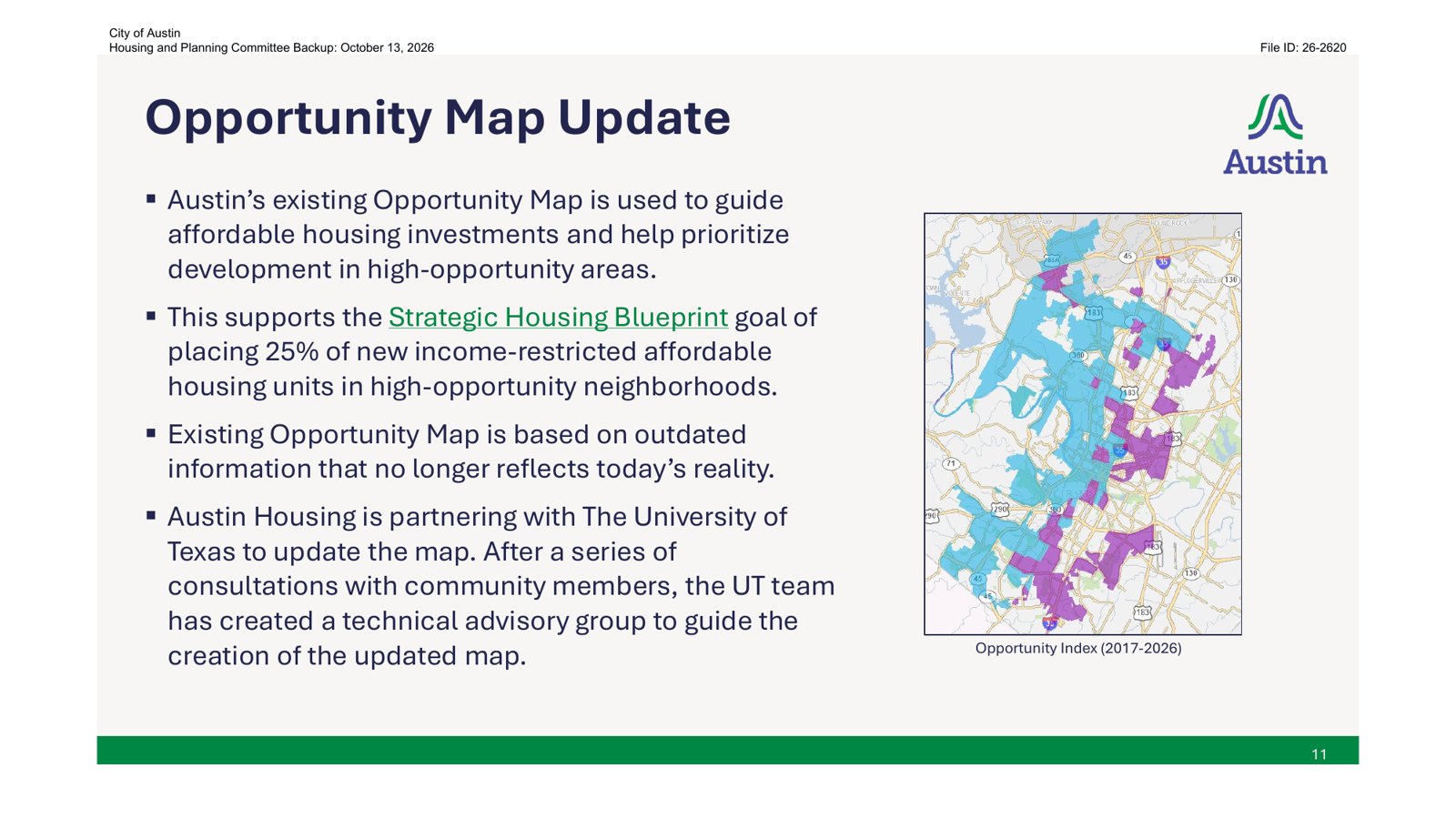
- The city’s “opportunity map,” which guides where subsidized housing goes, is being redrawn with the University of Texas. The old goal of putting 25% of new income-restricted units in high-opportunity areas was not met, the presentation says. Staff said the new method is due in early 2027.
- Staff said they’re aiming for Council adoption of the new blueprint in mid-2028, with help from a consultant team.
Members’ questions. Vela, referring to the Lamar-Rundberg area in his district, said the city brought rents down mainly by building a lot of housing, and asked how that lesson fits into the rewrite. Staff agreed and said the remaining gap is in deeply affordable units, according to the transcript. Siegel asked how the plan would spread affordable housing more evenly across the city. He also asked how much Project Connect anti-displacement money is left, and staff said they would follow up.
Harper-Madison focused on northeast Austin, where she said development is concentrating ahead of the infrastructure needed to support it. “Talk to me about wastewater plant that won’t be done for six years,” she said, according to the transcript (about 1:48 p.m.). She noted she is leaving the Council but said she will keep pressing on housing in northeast Austin.
Green social housing: not yet. The Council asked staff in February (Resolution 20260205-047) to study “green social housing.” That’s a model of publicly produced, permanently affordable, mixed-income housing. Erica Leak, a policy lead in the City Manager’s Office, and Paul Books, a principal planner with Austin Planning, presented the findings. Their briefing reviewed programs in Seattle, Atlanta and Montgomery County, Maryland. Montgomery County runs a $100 million revolving loan fund, according to the transcript.
The financial modeling found that the cross-subsidy behind those programs doesn’t work in Austin right now, staff said. In that setup, market-rate rents help pay for deeply affordable units. Austin’s falling market rents aren’t high enough to carry it without added subsidy. Staff estimated the city is about 55,000 units short for households under 50% of median family income.
- Staff recommended testing green social housing features in upcoming requests for qualifications on land owned by the Austin Housing Finance Corp., starting in early 2027.
- Staff said the first priority sites are 2908 S. Congress Ave. and 6200 Manchaca Road, followed by 4800 Bowen Road.
- A final report is due by December, after a second round of stakeholder engagement.
Siegel said Austin’s market conditions are unusual. A national social housing group that first offered to help concluded that its approach didn’t fit Austin’s falling rents and higher vacancies, he said, according to the transcript (about 2:21 p.m.).
Land development code update. Austin Planning staff briefed members on upcoming code amendments. A first phase of rules for data centers, which the Council requested in August (Resolution 20260827-061), is due by the end of 2026. A public open house is planned for spring 2027. Studies on parking maximums near transit and on redevelopment requirements for density bonus projects are slated for December, according to the presentation.
What’s next. The blueprint resolution goes to the full Council at a date not yet posted. Harper-Madison said she has one more meeting as committee chair. She proposed a future item on ways to help small, struggling neighborhood pockets, along with the capacity of community development corporations. Agendas and video are on the committee’s meeting page and ATXN.