Austin’s housing plan sets how many affordable homes the city aims for, for whom and where. That guides where city housing dollars go. The plan adopted in 2017 is reaching the end of its 10-year run. Tuesday, a Council committee is set to decide whether to ask the full Council to start rewriting it. The draft says the new plan should be ready in time to shape what a potential 2028 bond election asks voters to fund.
Preview: Austin City Council Housing and Planning Committee, regular meeting
Tuesday, Oct. 13, 2026, 1 p.m. CT. Austin City Hall, 301 W. Second St. Some members may join by videoconference. The meeting airs on ATXN.
Members: Chair Natasha Harper-Madison, Vice Chair Mike Siegel, José “Chito” Vela and Paige Ellis. Action is limited to committee members. An alternate votes only if a regular member is absent.
The city has posted a meeting page, the agenda (EDIMS 482745) and a 201-page agenda packet (EDIMS 482746) generated Oct. 7, which does not include backup posted Oct. 8–9. Item 3 also has a recommendation for action (File 26-2620, EDIMS 482749); Item 4 has an RCA (File 26-2617, EDIMS 482751); and Item 5 has an RCA (File 26-2622, EDIMS 482753).
The resolution: rewrite the Blueprint (Item 3). Harper-Madison and Siegel sponsor the item. Harper-Madison’s motion sheet asks the committee to recommend that the full Council approve the resolution “as presented in the Committee meeting backup” (EDIMS 482945). A committee vote would only send the item on. The full Council would still have to adopt it.
- Why now, per the draft. The 2017 Austin Strategic Housing Blueprint is nearing the end of its 10-year horizon. Other reasons the draft cites:
- Austin won a six-year HUD Pro Housing grant.
- Major transit investments are expected to reshape land use.
- The city has expanded its work to prevent displacement.
- Market and demographic changes call for a fresh look.
The draft also says the latest scorecard shows a particular need for homes affordable to households earning under 30% of median family income, for family-sized units and for units in high-opportunity areas (EDIMS 482944). The posted text of that clause appears garbled. It reads “below 30 percent MF family-sized units.”
- What the city manager would fold in. The update would cover:
- new production and preservation goals for affordable and “attainable” housing
- data on housing needs, supply and demand, and growth, using population projections, development pipelines, planned infrastructure and job trends
- displacement-prevention strategies
- affordability and stability strategies for renters and owners through public-private partnerships and work across departments
- The bond tie-in. The draft says “the updated Blueprint shall be completed in time to inform a potential 2028 bond program, providing Council and the community with current data, goals, and investment priorities necessary for bond development” (EDIMS 482944).
- Imagine Austin. Affordable housing needs would be “incorporated into Imagine Austin,” the city’s comprehensive plan. The goal, per the draft, is a more equitable spread of land uses that allows more kinds of housing citywide. The 2017 Blueprint was itself adopted as an amendment to Imagine Austin (Ordinance 20170413-010).
- Reporting. The manager would engage stakeholders, give Council regular updates, and set metrics, datasets and evaluation methods for annual reporting on the new goals.
What staff will show. Austin Housing’s deck lays out the groundwork (EDIMS 482750):
- Progress report. A new dashboard reviews the Blueprint’s 64 objectives. Objectives listed as high-impact so far include affordable-housing bond elections, the Strike Fund, strategic land banking, Low Income Housing Tax Credits, density bonuses and focusing federal funds on housing.
- Housing market analysis. It finds a major shortage of units affordable to renters below 50% of area median income, salaries not keeping pace with housing costs, and a declining share of “middle” housing types.
- Opportunity map update. The University of Texas is updating the map used to steer affordable housing into high-opportunity areas. The 2017 plan aims to put 25% of new income-restricted units in those areas. The final tool is due in early 2027.
- Timeline. The deck shows 2026 as preparation. The revision begins in 2027, and the deck lists “2028 Adopt Updated Blueprint.”
Where the 2017 goals stand. The 2017 plan set a 10-year target (2018–2028) of 135,000 new homes, including 60,000 affordable to households at or below 80% of median family income (city Blueprint page). The most recent scorecard on the city’s page covers 2024 (2024 scorecard; May 8, 2026, staff memo). It counts these units built from 2018 through 2024:
| Income level | Units built, 2018–2024 | 10-year goal |
|---|---|---|
| 30% MFI or below | 543 | 20,000 |
| 31% to 60% MFI | 16,067 | 25,000 |
| 61% to 80% MFI | 15,819 | 15,000 |
The same scorecard put 11% of new income-restricted units in high-opportunity areas, against a 25% goal.
The HUD grant. Austin Housing won a $6.7 million HUD Pathways to Removing Obstacles (PRO) Housing grant, to be spent over six years. Of that, $750,000 goes to updating the Blueprint and the opportunity index (city PRO Housing page).
Green Social Housing briefing (Item 4). Erica Leak, housing policy lead in the City Manager’s Office, presents with Paul Books, a principal planner with Austin Planning, and Courtney Banker, housing development manager with Austin Housing. They respond to Council’s Green Social Housing resolution, No. 20260205-047. The resolution asked staff to evaluate publicly produced, permanently affordable, mixed-income and green housing, including a possible revolving loan fund (EDIMS 482752).
- Models reviewed. Staff looked at Montgomery County, Md. ($100 million revolving fund seeded in 2021), Seattle’s social housing developer (funded by a tax on employer-paid compensation over $1 million), Atlanta and Chattanooga.
- Findings.
- A revolving loan fund can support mixed-income building. But staff found it unlikely to make projects pencil out under current market conditions without more subsidy and permanent financing.
- Today’s lower market-rate rents don’t cross-subsidize the cheaper units.
- In softer-rent areas, tax credits remain the more cost-effective path to deep affordability.
- Extra requirements such as workforce programs, living wages and green premiums raise costs and shrink the developer pool.
- Staff prefer an independent entity to the city acting as guarantor and landlord.
- Recommendations.
- Keep testing alternative models.
- Use the Blueprint update to identify needs and partners.
- Build Green Social Housing features “as feasible” into upcoming requests for qualifications on land owned by the Austin Housing Finance Corporation (AHFC).
A chart in the deck shows about 87,000 renter households at or below 50% of median family income. It shows about 31,500 occupied rental units affordable to them, a gap of 55,464 units.
- AHFC today. The corporation’s portfolio is about 4,350 units: more than 3,860 in operation and 500 in development. About 52% serve households at or below 50% MFI. It also holds 117 acres of vacant land. The deck’s timeline shows a second stakeholder round and a final report following this briefing, late in 2026.
Land Development Code amendments status (Item 5). Stevie Greathouse, division manager with Austin Planning, updates the committee on Title 25 work (EDIMS 482868; schedule, version dated Sept. 25, EDIMS 482869).
- Adopted May–September 2026:
- the citywide density bonus program and transit-related amendments (May 21)
- Downtown Density Bonus Phase 1 (May 28)
- fee-in-lieu eligibility for the citywide bonus (Sept. 10)
- Due by December:
- four studies or memos on ETOD parking maximums, redevelopment requirements for density-bonus projects, a streetscape and urban design work plan, and unbundling parking
- a “relocating non-zoning regulations” amendment for Council adoption
- Data centers. Council’s Resolution 20260827-061 directed data-center rules, with a first phase by year’s end. Staff describe a two-phase approach. It covers land-use definitions by type and scale, the zones where each use is allowed, conditional or prohibited, operations plans, possibly a new zoning district, and a public open house in spring 2027. Staff say the overall code timeline was adjusted for this work “but timelines may continue to shift.”
- 2027 and beyond:
- East Riverside Corridor Plan update and Downtown Density Bonus Phase 2 (March–April 2027)
- life science land use, Data Center Phase 2 and tobacco sales use (March–May 2027)
- mixed-use zoning districts (April–May 2027)
- park improvement permitting and HOME Improvement Phase 1 (fall 2027)
- middle residential zoning districts (October–November 2027)
Also on the agenda.
- Item 2: the committee’s 2027 meeting schedule. No draft calendar is posted.
- Item 6: future items.
- Four memos are listed for information only and are not for discussion: ETOD implementation (July 24), large data centers (Aug. 19), the Downtown Density Bonus Phase 2 work plan (Sept. 8) and a transfer-of-development-rights market analysis (Sept. 30). All are in the packet.
How to take part. Speak in person or by phone. You may register only once per item. Items posted for possible action (Items 1–3) are open for sign-up. Briefings (Items 4–5) are not. Up to five general-communication speakers get three minutes each. Instructions are at the Council Committee Information Center. ADA help: 512-974-2210 (TTY: 711).
Bond elections. On Oct. 8, Council directed the city manager to plan omnibus bond elections starting in fiscal 2028 and again in fiscal 2034, with affordable housing among the required categories. If the committee advances the Blueprint resolution, it would go to a coming full Council agenda. The Oct. 22 Council draft agenda, as posted, does not list it.
How the process works. Committees can’t adopt city policy. They recommend items to the full 11-member Council. This resolution would only start the rewrite. The finished Blueprint would come back for adoption later. Because the 2017 plan was adopted as an amendment to Imagine Austin (Ordinance 20170413-010), a replacement would likely be one too.
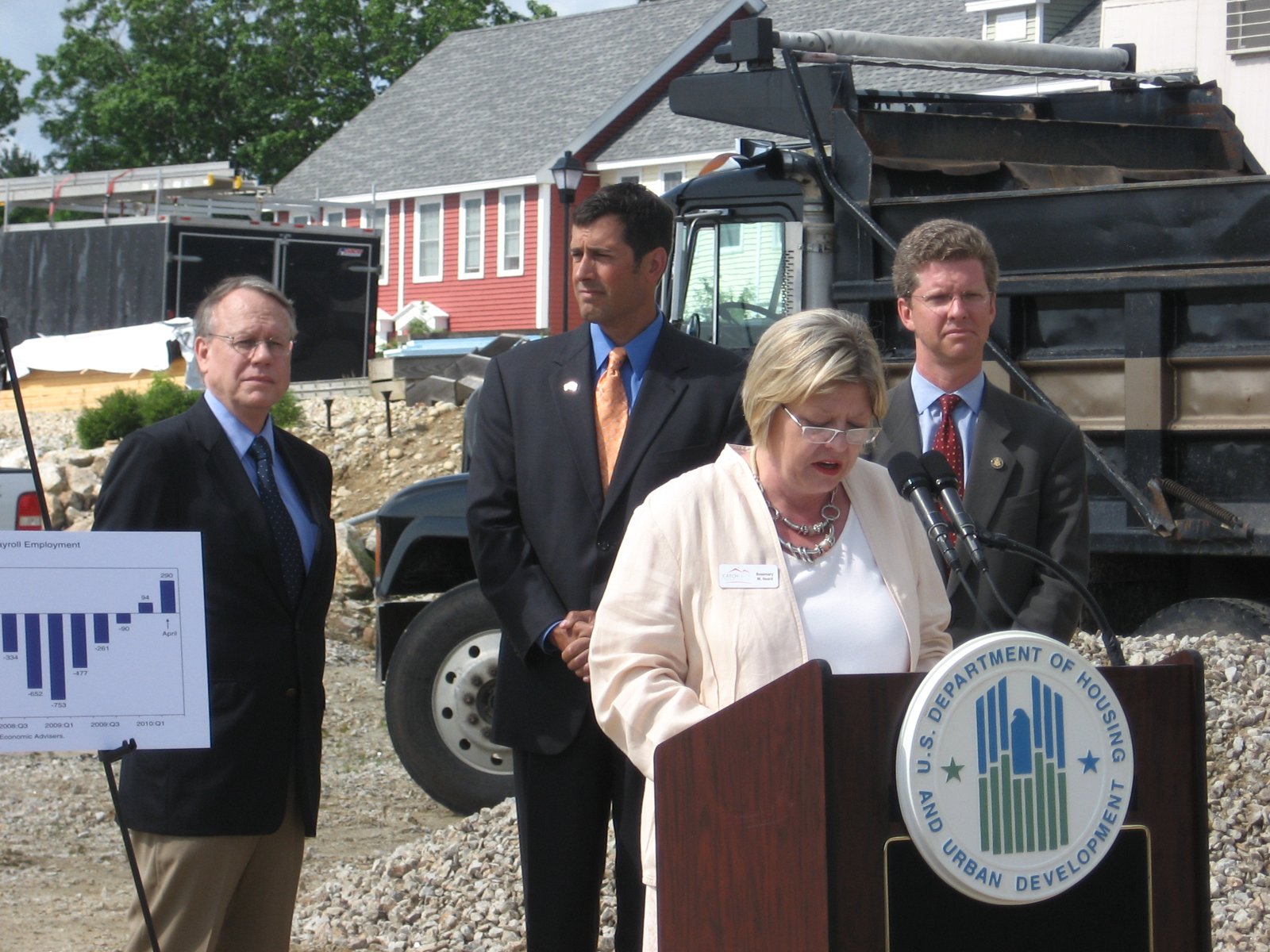
Officials at a June 4, 2010, HUD event at Bow Highlands, an affordable housing project then under construction in Bow, N.H. Photo by Jack and Rhonda Siciliano, HUD, public domain, via Wikimedia Commons.
