This article is enhanced by Local Insights Pro.
City Council members who oversee Austin’s public health and homelessness spending will see how many people the city’s encampment cleanups have connected to shelter, what the effort has cost and how the city plans to expand storage for people living outside, and they could act on who represents the city on the Central Health board.
The Austin City Council’s Public Health Committee meets Wednesday, Nov. 4, 2026, at 10 a.m. at Austin City Hall, 301 W. Second St., to discuss and possibly act on appointments to the Central Health Board of Managers and on a social services strategy, and to hear an update on the city’s Homeless Encampment Management initiative, according to the agenda. Chair Vanessa Fuentes, Vice Chair Marc Duchen and Council Members and José Velásquez sit on the committee. Some members may take part by videoconference.
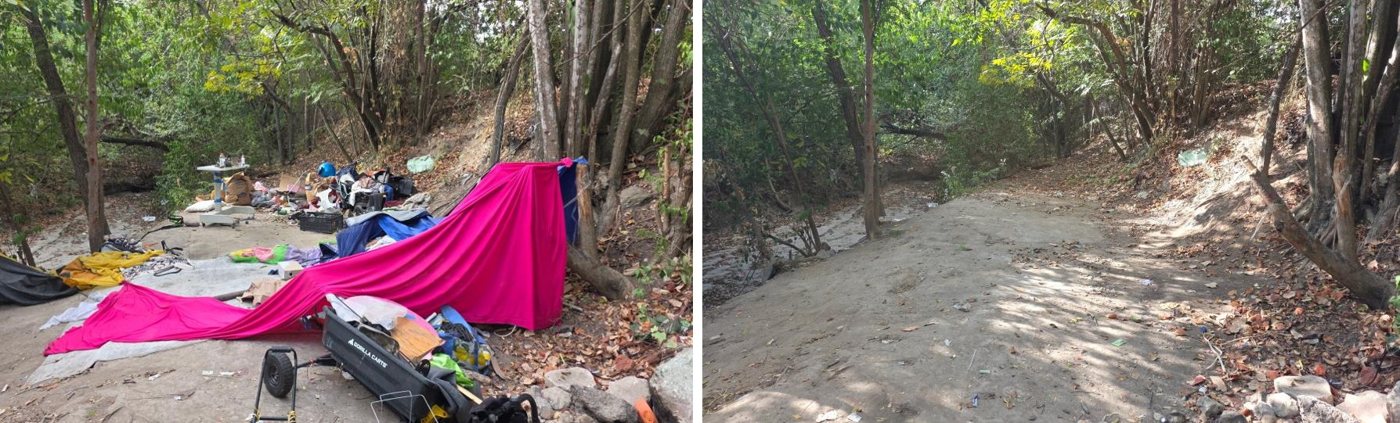
Encampment cleanup results: David Gray, director of Austin Homeless Strategies and Operations, is scheduled to brief the committee on the Homeless Encampment Management initiative, which the agenda describes as a coordinated approach of outreach, enforcement, site management and public space restoration. The department’s presentation says the process was created to comply with Proposition B and Texas Penal Code 48.05. From May 11 to Sept. 30, 2026, the slides report:
- 780 distinct sites visited, with 2,803 total site visits.
- 1,035.89 tons of debris removed.
- 171 people connected to shelter and 93 connected to supportive services; 45% of the 581 people contacted accepted shelter or services.
- 55 people cited and five arrested.
- 3,758 encampment service requests through Austin 3-1-1, with an average response time of 4.05 days.
- 24% of encampment sites remained clear of any return activity after abatement and closure.
What it costs: The slides put the initiative’s cost for June 8 to Sept. 30, 2026, at $2,260,803.14, or $963.27 per site visit, which they say is 39% less than the prior reporting period’s $1,577.55. Austin Police ($505,944.66), Austin Resource Recovery ($502,999.83), Austin Transportation and Public Works ($457,374.28) and Austin Watershed Protection ($389,654.71) had the largest shares. Staff salaries made up 71% of costs and contractors 23%. The presentation says the staff positions are already in departments’ budgets and cannot be shifted to pay for social services or housing.
Changes in how cleanups work: According to the presentation, Austin Resource Recovery has replaced the transportation department on roadway cleanups, Austin Emergency Management no longer collects the initiative’s data, and the homelessness office is hiring three full-time staff for its Public Space Management team. Once outreach is done, that team gives 72 hours’ notice before closing a new site and 24 hours’ notice at sites the city has designated Keep Clear. A new online Keep Clear map shows sites that have been through the process, where the slides say camping will be quickly abated. The department’s street outreach program is hiring and training staff for three two-person teams covering North, Central and South Austin.
Storage and shelter: Austin Community Court is weighing how to use a one-time $500,000 allocation to expand storage for people experiencing homelessness, including through nonprofit partners or established storage providers, and is exploring a mini-grant process, the slides say. The presentation also lists 100 more shelter beds at Esperanza Community and two permanent supportive housing communities opened since June 2026 with city money: Seabrook Square II, with 60 units, and Cairn Point Cameron, with 100.
Central Health board appointments: The committee could act on appointments to the Central Health Board of Managers (Item 4) after a closed-door discussion of candidates under the Texas Open Meetings Act’s personnel exception (Item 7). The City of Austin and Travis County each appoint four members to the hospital district’s board and jointly choose a ninth, according to Central Health. The agenda backup does not name candidates or seats.
Social services strategy: Item 5 is a discussion and possible action on a social services strategy covering a solicitation overview, pay for performance, grants versus contracts, and stakeholder engagement, according to the agenda backup. At the committee’s Oct. 7 meeting, budget staff presented a social services reset timeline under which solicitations and agreement changes for all issue areas would happen in fiscal 2027, with all agreements in effect by fiscal 2028, according to the presentation, as the Dispatch reported.
How to speak: Public comment is allowed in person or by phone on items posted for possible action; briefings, including the encampment update, are not open for sign-up. Up to five speakers may address topics not on the agenda for three minutes each during general public communication. Instructions are on the city’s Council Committee Information Center.