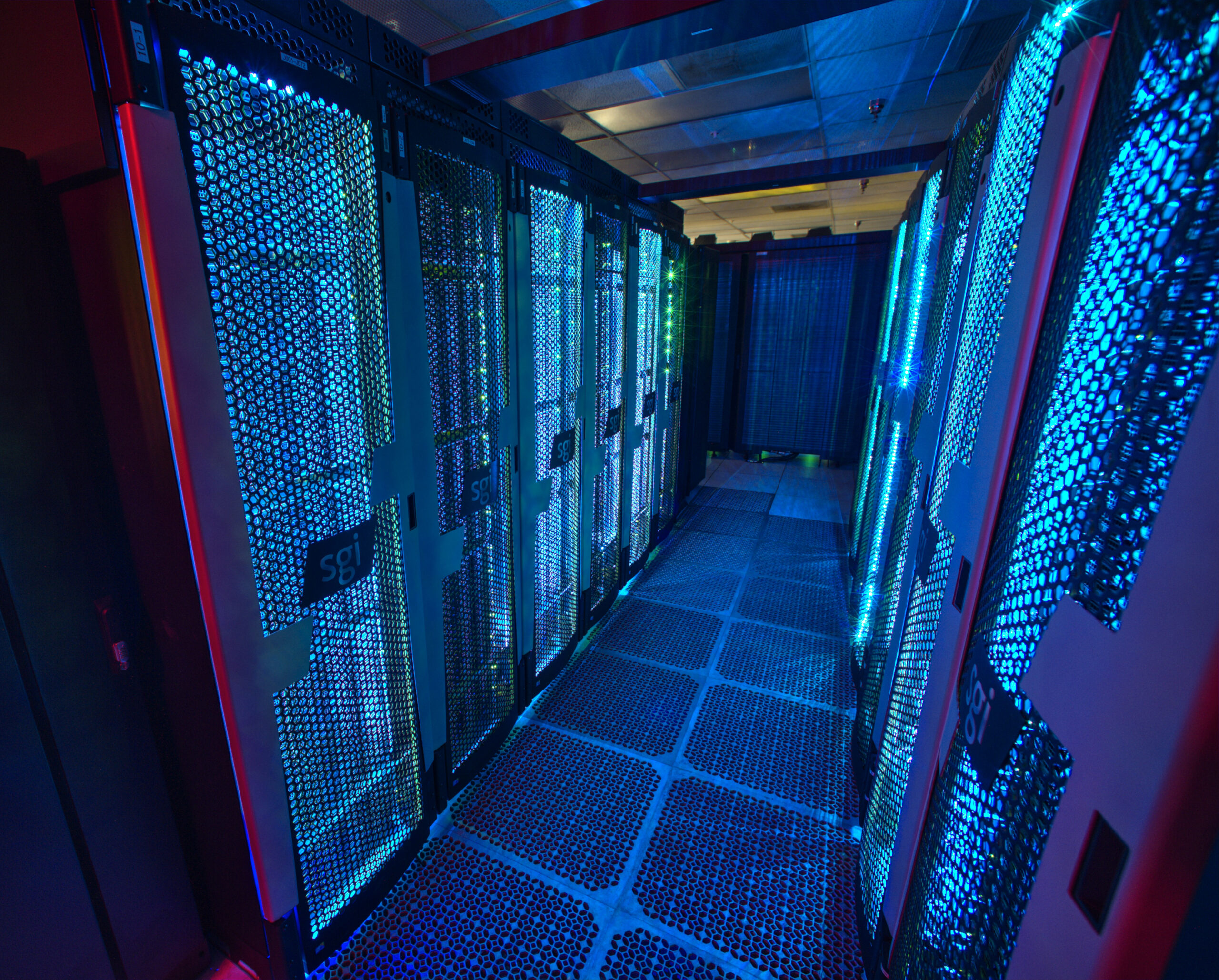
Horizon, the National Science Foundation’s $457 million bet on academic supercomputing, is now running science, but only half of it is built.
The University of Texas at Austin’s Texas Advanced Computing Center (TACC) has opened Horizon’s 4,000-GPU system to early users, UT announced Nov. 17. The machine sits in a data center in Round Rock. Its CPU half, built on NVIDIA’s Vera processors, is due in early 2027.
Where it ranks. Horizon debuted at No. 24 on the November 2026 TOP500 list of the world’s fastest supercomputers. It delivered 132 petaflops on the list’s standard benchmark, against a theoretical peak of about 167 petaflops, according to its TOP500 entry. That makes it the most powerful academic supercomputer in the United States, UT says.
The systems above it on the list belong mostly to national labs, governments and companies. The fastest, at 2,198 petaflops, is a Chinese system in Shenzhen. The U.S. Energy Department’s El Capitan, at Lawrence Livermore National Laboratory, is second at 1,809. One university system ranks higher than Horizon: Britain’s Isambard-AI, at the University of Bristol, is No. 15. UT’s claim is limited to the U.S.
Who uses it. Horizon is the centerpiece of the NSF Leadership-Class Computing Facility. NSF picked TACC to run that facility in July 2024 with an initial $457 million for construction. Computing time is open to researchers nationwide through peer review rather than reserved for UT.
UT’s release lists a long set of uses, including AI work, earthquake science, quantum materials and astronomy. Fernanda Leite, UT’s vice president for research, pitched it closer to home, saying it can model how a flash flood would move through a Hill Country watershed or stress-test the power grid before a winter storm.
The release does not say how many research teams are on the system now, which projects got early access or when Horizon moves into full production.
The gap. TACC retired Frontera, its previous NSF flagship, in October after more than seven years and 8 million jobs, according to the release. Horizon was designed to deliver 10 times Frontera’s simulation performance. UT’s own 2024 announcement said the facility was expected to begin operations in 2026, and the early-user launch meets that timeline. The full machine won’t be in place until next year.
The design has also shifted. In November 2025, the trade publication The Next Platform reported that Horizon’s expected peak double-precision performance had dropped from about 400 petaflops to 300. TACC did not explain the change, the publication said, and suggested rising GPU costs might be a factor. UT’s current spec sheet lists 140 peak petaflops for the GPU half and a projected 180 for the full system. That’s a different measure from the Next Platform figures, and the two can’t be compared directly. TACC’s user documentation describes the planned CPU partition as 4,752 Vera nodes.
Why Round Rock. Horizon is housed at Sabey Data Centers’ campus at 1300 Louis Henna Blvd., which UT describes as a new 20-megawatt facility with liquid cooling. The City of Round Rock approved a performance-based incentive deal with Sabey in 2022. It requires at least $185 million in property improvements and 20 jobs over five years in exchange for up to $1 million in sales-tax-funded payments, according to the city. The NSF budget includes rent paid to Sabey, The Next Platform reported.
Dell Technologies, NVIDIA and VAST Data built the system. With Horizon added, TACC says it now has nearly 5,500 GPUs, more than any other U.S. university. TACC is headquartered at UT’s J.J. Pickle Research Campus in North Austin. Its other production systems include Vista, Lonestar6 and Stampede3.