Austin Water is drafting new rules for the city’s largest water users, such as data centers and chip plants, and its own citizen advisers say they haven’t had enough time or data to weigh in. At an Oct. 13 meeting, members of the Water Forward Task Force asked staff for an extra session in late October or early November so they can shape the recommendations before Austin Water takes them to a City Council committee on Dec. 9.
What Austin Water is proposing. The City Council passed a resolution on July 23 directing staff to develop rules for large-volume water users, staff told the task force, according to the meeting video. The briefing was led by Marisa Flores Gonzalez, water resources team supervisor, and Emlea Chanslor, Austin Water’s chief of staff, according to the agenda. The draft concepts, shown on open house boards posted with the agenda, include:
- A “high impact” class. Commercial, industrial and manufacturing customers whose past or projected water use tops 85 million gallons a year would be covered. Staff said that number matches the threshold Austin Water already uses for its large-volume customer class.
- Earlier review. A project’s expected water use would be flagged when a developer first asks about utility service, and water benchmarking would be required at the site-plan stage.
- Conservation plans. Each high-impact user would need its own water conservation plan with five- and 10-year goals, updated every five years. A plan that falls short of Austin Water’s standards would need Council approval.
- Enforcement and reporting. Options include corrective action plans, charges for excess use, penalties and water budgets with higher rates for use above the budget. Expanded annual reporting on the biggest users could begin in May 2027.
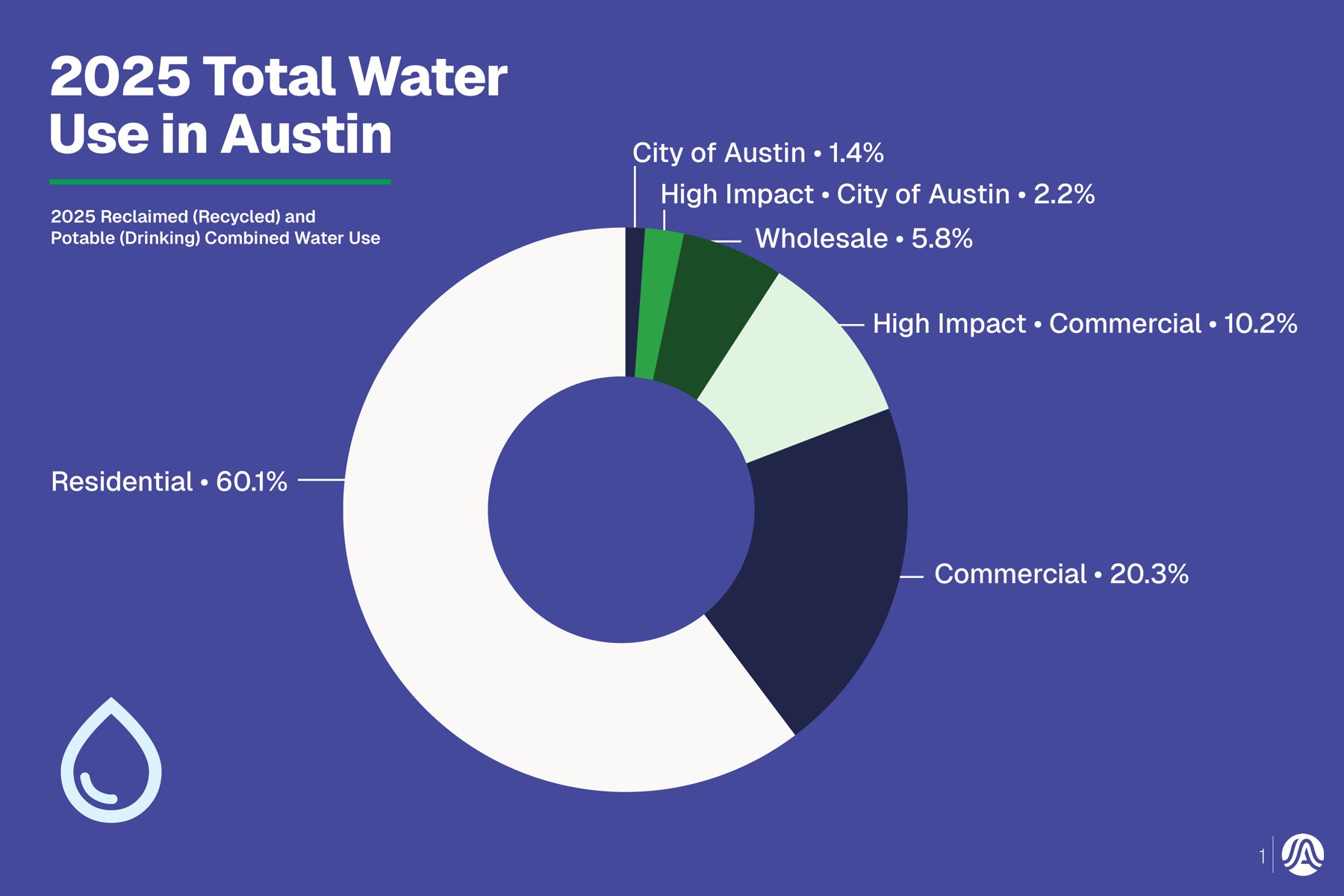
Staff said 28 people attended an Oct. 5 open house at the Permitting and Development Center and 11 turned in written surveys. An online survey on the city’s SpeakUp Austin site had drawn about a dozen responses and was set to close Oct. 18. According to the boards, Austin’s supply is about 325,000 acre-feet a year, and the city now uses about 175,000. Residential customers accounted for about 60% of 2025 water use. Users the boards label high impact made up 10.2% (commercial) and 2.2% (city facilities).
Cooling towers and the LCRA trigger. Task force members pressed staff on several points, according to the video:
- Closed-loop cooling. Vice Chair Robert Mace asked whether the city would require closed-loop cooling systems. He said open-loop systems can use roughly a million gallons a day for every 100 megawatts and noted that Tempe, Phoenix and Las Vegas restrict them. Staff said they are discussing whether to require closed-loop cooling for developments with high cooling demand, and noted the Council has a separate resolution on data centers.
- Costs to ratepayers. Chair Jennifer Walker asked how the rules would protect affordability and how close Austin is to the point where it must start paying the Lower Colorado River Authority for more water. Under the city’s 1999 agreement with LCRA, those payments begin once Austin uses more than 201,000 acre-feet a year for two years in a row, according to Austin Water. Staff said that when the deal was signed, the city expected to hit that mark around 2015, and it still hasn’t.
- A hard line at 85 million. Member Paul DiFiore asked how the public would be notified about large projects. He said a strict 85-million-gallon cutoff could seem arbitrary for projects just below it and suggested commissions review the plans before the Council has the final say.
- Pollution. Member Madelline Mathis asked about PFAS, the so-called forever chemicals, in discharges from data centers and semiconductor plants. Staff pointed to the city’s industrial pretreatment program and said a framework for that issue isn’t fully developed.
Member Sarah Faust said affordability for residential customers was the reason she helped write the task force’s earlier recommendations on large users. She cited Tesla’s rising water use and the city’s push to recruit manufacturers and data centers. She said new water supplies and the LCRA payments are where costs climb fast. She reminded staff that the recommendations the task force sent to the Council on June 9 called for closed-loop cooling and non-potable water for data centers. She also asked for data explaining why 85 million gallons is the right threshold, saying members had no way to judge the number without it.
Why the timing matters. The task force meets every other month, and its August meeting was canceled for lack of a quorum, members noted. Its next regular meeting is Dec. 8, the day before the committee briefing. Staff said that is too late to fold in the task force’s feedback, because the recommendations must go through department and city review first. Members agreed to aim for an extra meeting in the last week of October or the first week of November. Staff will send out possible dates and will ask members to send their questions and data requests in advance. If a quorum can’t be reached, a smaller group could still meet, staff said.
Lakes are full, for now. Emily Rafferty, an Austin Water program manager, told the task force that heavy rains in July filled lakes Buchanan and Travis for the first time since 2019. That ended the water-supply drought, according to her presentation. Combined storage stood at about 1.99 million acre-feet, or 95% full, though much of Travis County remains in severe drought on the U.S. Drought Monitor. Federal forecasters expect a strong El Niño to last through early 2027, which usually means a wetter winter in Central Texas. Staff also gave an update on the city’s water reuse programs. They reported that customers used more than 1.8 billion gallons of reclaimed water in 2025.
What’s next. Austin Water is scheduled to present its large-user recommendations to the Council’s Climate, Water, Environment and Parks Committee on Dec. 9, and the public can comment at that meeting. The task force’s next regular meeting is Dec. 8. Meeting materials are on the Water Forward Task Force page.