Early voting opens Monday, Oct. 19, and Austin voters will decide Proposition A, a $260 million parks bond. Most of the debate so far has been about cost and timing. A plainer question gets less attention: Would the money fix the gaps in where Austinites can actually exercise?
Two public data sets give a partial answer. The first is the Trust for Public Land’s 2026 ParkScore report for Austin. The second is the city’s prioritized project list for the bond. Read together, they show a parks system that is easy to walk to and well funded, but short on the courts, fields and recreation centers where much organized exercise happens. Prop A puts real money into pools, trails and land. It names much less for fields and courts.
How Austin scores
Austin ranked 47th of the 100 largest U.S. cities in the 2026 ParkScore index, with 54 of 100 points, according to the TPL report. Its strongest results:
- Access (67 points). 76% of residents live within a 10-minute walk of a public park.
- Investment (72 points). Spending on public parks averages $236 per resident across all agencies and groups, a three-year average. The TPL city page puts the average among the 100 largest cities at $154.
Austin’s weakest category is amenities, at 35 points. That category counts the places people actually use to get exercise. Austin’s results, compared with the other 99 cities:
- Athletic fields and diamonds: 100, or 0.97 per 10,000 residents. That earned 1 point of 100.
- Basketball hoops: 235, worth 19 points.
- Recreation and senior centers: 25, or 0.49 per 20,000 residents. That earned 24 points.
- Playgrounds: 252, worth 40 points.
- Splash pads: 11, worth 36 points.
TPL’s counts can differ from the city’s own inventory. The report says it combines all public and private park providers in the city to compare cities fairly.
The equity numbers stand out. Austin scores above average on walking distance for people of color and for low-income households: about 75% of each live within a 10-minute walk of a park. The amount of nearby park space is a different story. TPL found that residents of lower-income neighborhoods have 74% less nearby park space than residents of higher-income neighborhoods. Residents of neighborhoods of color have 50% less than residents of white neighborhoods. Austin scored 11 and 38 of 100 on those two measures.
Why it matters for health
About 27% of Travis County adults were obese in 2023, up from 22% in 2019. That’s according to Texas Behavioral Risk Factor Surveillance System data compiled by Austin Public Health and published on the CAN Community Dashboard. The same data put the 2023 rate at 36% for Hispanic residents and 24% for non-Hispanic white residents. Survey estimates like these have margins of error. The dashboard says it leaves out estimates that don’t meet reliability thresholds.
No bond can show that a new pool or trail lowers a county’s obesity rate. Still, the Austin/Travis County Community Health Plan lists physical activity among the region’s wellness priorities. And parks are one of the few health levers the city controls directly.
What Prop A would buy
The official election notice lists Prop A’s purposes, with priority given to:
- Buildings: improvements at Gus Garcia Recreation Center, Doris Miller Auditorium and Mayfield Park.
- Infrastructure: sites including Williamson Creek Trail, the Onion Creek all-abilities playground, St. Edward’s Greenbelt Trail & Park, Zilker and Circle C metro parks, and citywide park electrification.
- Parkland improvements: 12 named parks, from Jamestown Neighborhood Park to Walter E. Long Metro Park.
- Pools: Garrison Municipal Pool, Big Stacy Neighborhood Pool, Walnut Creek Municipal Pool and Civitan Neighborhood Pool.
- Land: acquisition, with priority for infill parks in park-deficient areas, greenways for trail connectivity, and destination parks.
The Austin Current reported these category amounts when Council finalized the package Aug. 6:
- $65.5 million for buildings
- $65 million for parkland improvements
- $65 million for the four pools
- $35 million for acquisition
- $29.5 million for infrastructure
The notice does not list dollar amounts by category.
Where Prop A lines up with the gaps, and where it doesn’t
- Fields. Austin’s lowest ParkScore measure is athletic fields, yet the bond names little for them. The city’s pre-election project list says infrastructure money covers “athletic fields and facilities” generally. The only field project it names is “Onion Creek Metro Park Soccer Fields (D2),” listed under parkland improvements. The ballot language says Onion Creek Metro Park without mentioning soccer fields. On paper, Prop A does not put a dollar figure on sports fields.
- Recreation centers. Austin’s 25 centers earned 24 of 100 points. Prop A would fund a senior-wing addition at Gus Garcia Recreation Center, according to the project list. It would also buy land for a new center, though not build one. The documents disagree on where. The final ordinance and the election notice say “a new recreation center in District 6.” The city’s Aug. 4 project list said “a new southeast recreation center.” Council District 6 is in Northwest Austin. Voters may want the city to clarify which is meant.
- Pools. The $65 million for four pools is a quarter of the bond. TPL’s ParkScore doesn’t score pools, so the index can’t show whether Austin is short on them. The bond would renovate or replace existing pools rather than add new ones.
- Park-deficient areas. The acquisition category is the one most directly aimed at the equity gap TPL measured. The ballot language puts infill parks in park-deficient areas first on its priority list for land. But the $35 million in that category is also meant for greenways, destination parks such as land along the Colorado River, and the recreation-center site. The documents don’t say how it would be divided.
- Trails. Williamson Creek Trail and St. Edward’s Greenbelt Trail & Park are named infrastructure priorities. Greenways “for increased trail connectivity” are also an acquisition priority.
What it would cost
The ballot labels Prop A “THIS IS A TAX INCREASE,” as state law requires. The voter information document gives these estimates:
- Interest: $193,357,500, assuming a 6% rate.
- Homeowner cost: a maximum annual tax increase of $8.14 for every $100,000 of a homestead’s appraised value.
The Austin Current reported that Props A and B together would add roughly $40 a year to the city tax bill on a median-valued home of about $485,000, and less if spending is spread out.
Timing is the main argument against the bond. City financial staff had recommended waiting until 2028, when earlier bond programs would be largely spent, according to the Austin Current. Mayor Kirk Watson and two Council members voted against calling the election on Aug. 4 for that reason. Council then voted unanimously Aug. 6 to place both propositions on the ballot. Supporters argued that parks need is urgent after years without a parks bond, and that the parks department had committed most of its 2018 bond money. Dispatch’s earlier look at the city’s new bond tracker shows how much of past bonds has been spent and what was dropped.
What to watch
If Prop A passes, three things would show whether it narrows Austin’s exercise gaps:
- How much of the $35 million for land goes to infill parks in park-deficient neighborhoods, compared with greenways and destination parks.
- Whether the city spells out which area the new recreation center would serve.
- Whether the general infrastructure category puts measurable money into fields and courts, Austin’s lowest-scoring amenities.
Bond-funded park projects typically take years to design and build, so any change in ParkScore results would come later.
How to vote
- Early voting: Monday, Oct. 19, through Friday, Oct. 30, generally 7 a.m. to 7 p.m. Registered Travis County voters may use any county polling site, according to the Travis County Clerk.
- Election Day: Tuesday, Nov. 3, 7 a.m. to 7 p.m.
- Also on the ballot: Proposition B, a $35 million library bond.
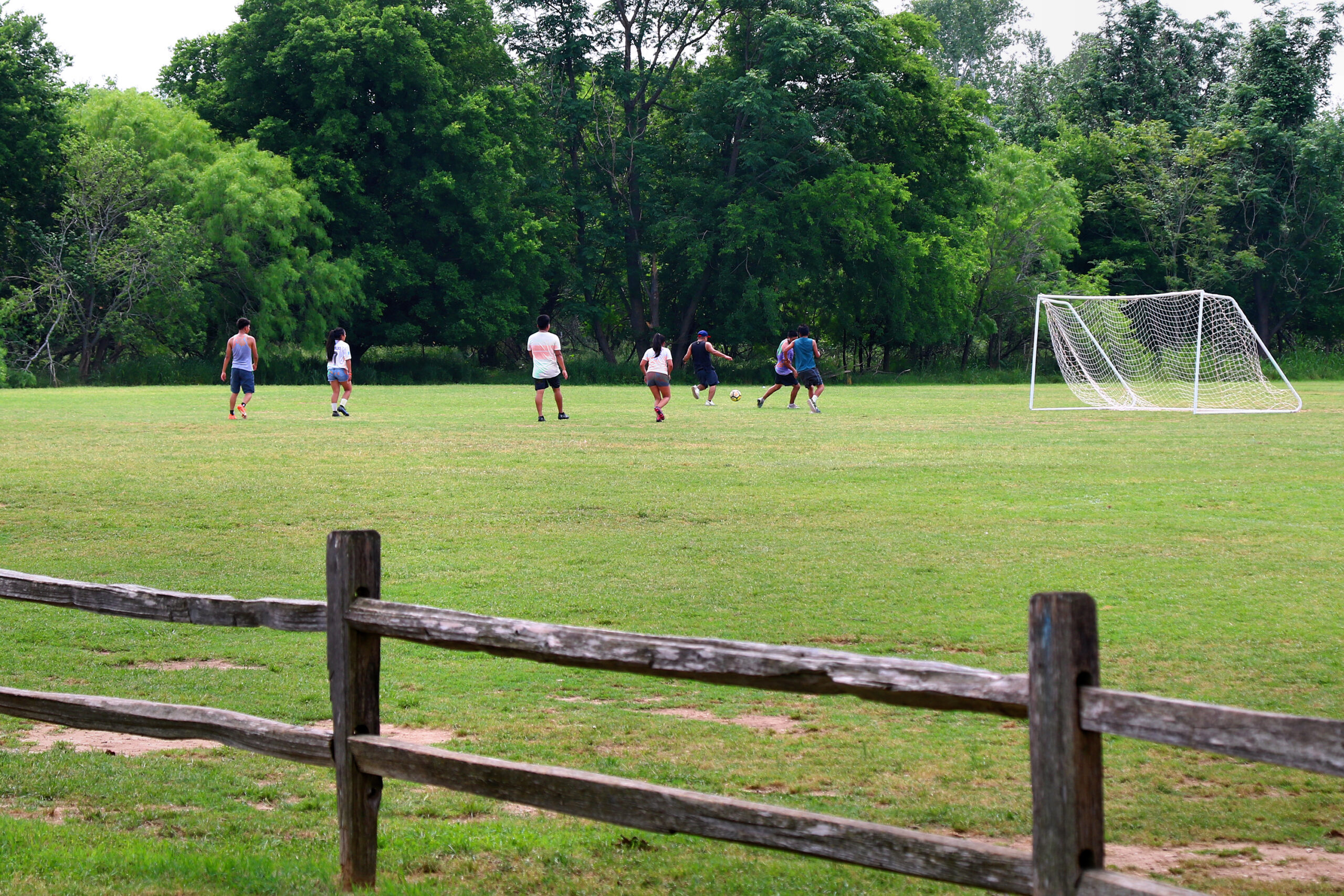
Featured image: A pickup soccer game on a multi-use field at Roy G. Guerrero Colorado River Metropolitan Park in Austin, April 2024. Photo by Larry D. Moore, CC BY 4.0, via Wikimedia Commons.
