Austin Energy plans to spend about $1 billion on new gas-fired peaking capacity to cover what it calls a 400-megawatt reliability gap, and the cost of that project falls on the utility’s customers. On Oct. 20, the city’s Resource Management Commission asked the City Council to pay for an outside study of whether batteries, efficiency, demand response and other carbon-free resources could complement or replace the plant.
The recommendation. The commission voted 8-0, with Chair Charlotte Davis abstaining, to approve Recommendation No. 20261020-004. Vice Chair Paul Robbins made the motion and Commissioner Trey Farmer seconded it. The recommendation asks Council to direct the city’s Financial Services Department to hire an independent consultant, chosen through a competitive process and with no financial ties to any generation technology vendor, equipment maker or market participant, or to members of the commission or the Electric Utility Commission. The study would be public and would:
- Update the peaker. Quantify the gas plant’s likely cost and delivery date given recent increases in turbine and transformer costs and lead times.
- Test alternatives. Evaluate at least seven resource types: utility- and customer-scale battery storage; grid reconductoring and transmission upgrades; expanded energy efficiency and demand response; time-of-use and real-time pricing; vehicle-to-grid and smart electric vehicle charging; additional renewable technologies including geothermal; and virtual power plants.
- Compare portfolios. Assess whether any combination could meet Austin Energy’s goal of reducing about 575 annual reliability risk hours at or below the roughly $1 billion peaker budget, and identify barriers to deployment.
- Report back. Finish by October 2027 and present findings to the Resource Management Commission and Electric Utility Commission in public meetings before they make recommendations to Council.
The document says the utility’s Resource, Generation and Climate Protection Plan to 2035 and Council’s approval of the peaker rest on cost and technology assumptions from mid-2024. It cites a 64% increase in Henry Hub natural gas prices between August 2024 and October 2026 and higher gas turbine and transformer costs. It also reaffirms the commission’s support for Austin Energy’s existing efficiency, renewable and battery programs.
The debate. According to the meeting transcript, Farmer said he and Commissioner Alison Silverstein had met with Austin Energy’s Lisa Martin, and he pointed commissioners to her written response. Silverstein said the proposal was not an effort to undo the peaker decision, which she said had already been made, but a check on whether other resources could add flexibility and lower costs.
Davis asked whether the study would duplicate modeling Austin Energy already obtained from its consultant, Ascend Analytics, and noted that an outside study would cost ratepayers several hundred thousand dollars. Another commissioner responded that the commission had not seen Ascend’s work and so could not tell whether the analysis had already been done. Davis did not state a reason when she abstained.
The commission first voted, 7-0 with one abstention according to the transcript, to add “additional renewable technologies including geothermal” to the list of resources at the request of Commissioner Martin Luecke. A second amendment, proposed by Robbins, extended the conflict-of-interest language to cover financial ties to commission members.
Battery deal and rebates. Commissioners also heard two staff briefings:
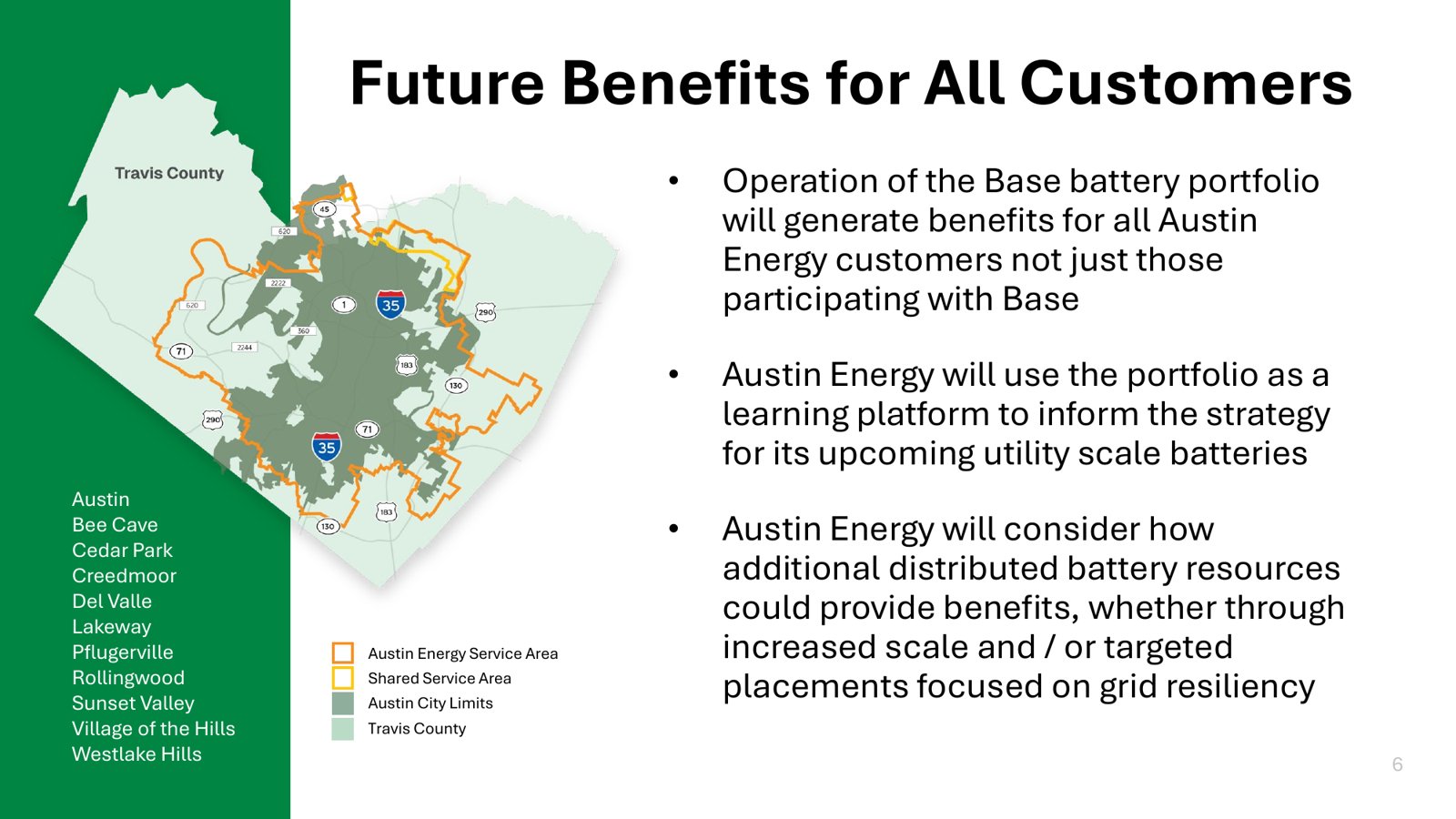
- Base Power. Pat Sweeney, Austin Energy’s interim vice president of market operations and resource planning, outlined the utility’s agreement with Base Power, which Council approved April 23. The 10-year agreement covers up to 40 megawatts of home batteries, about 2,000 to 2,500 installations ramping up over roughly 18 months starting in summer 2026, at about $4 million a year. The batteries are counted toward the city’s 125-megawatt local storage goal, and the presentation says the utility will use the portfolio to inform its plans for utility-scale batteries.
- Heat pumps and air conditioners. Hammad Chaudhry, Austin Energy’s director of energy efficiency services, described rebates of $600 to $1,600 per unit and the utility’s estimates of more than 27,500 homes and 22.5 megawatts of demand savings over 10 years, plus more than 71,500 multifamily units and 32.8 megawatts.
The commission also voted 8-0 to adopt a resolution placing a standing item on its agendas, starting in November 2026, to comment on Austin Energy requests for Council action. According to the transcript, a joint working group on long-duration energy storage, with members from both utility commissions, will next meet Nov. 5.
What’s next. The study recommendation goes to the City Council, which has not scheduled action on it. The commission’s Oct. 20 agenda and backup are posted on the city’s boards and commissions site. The Dispatch’s preview of the meeting has more background on the peaker plan.