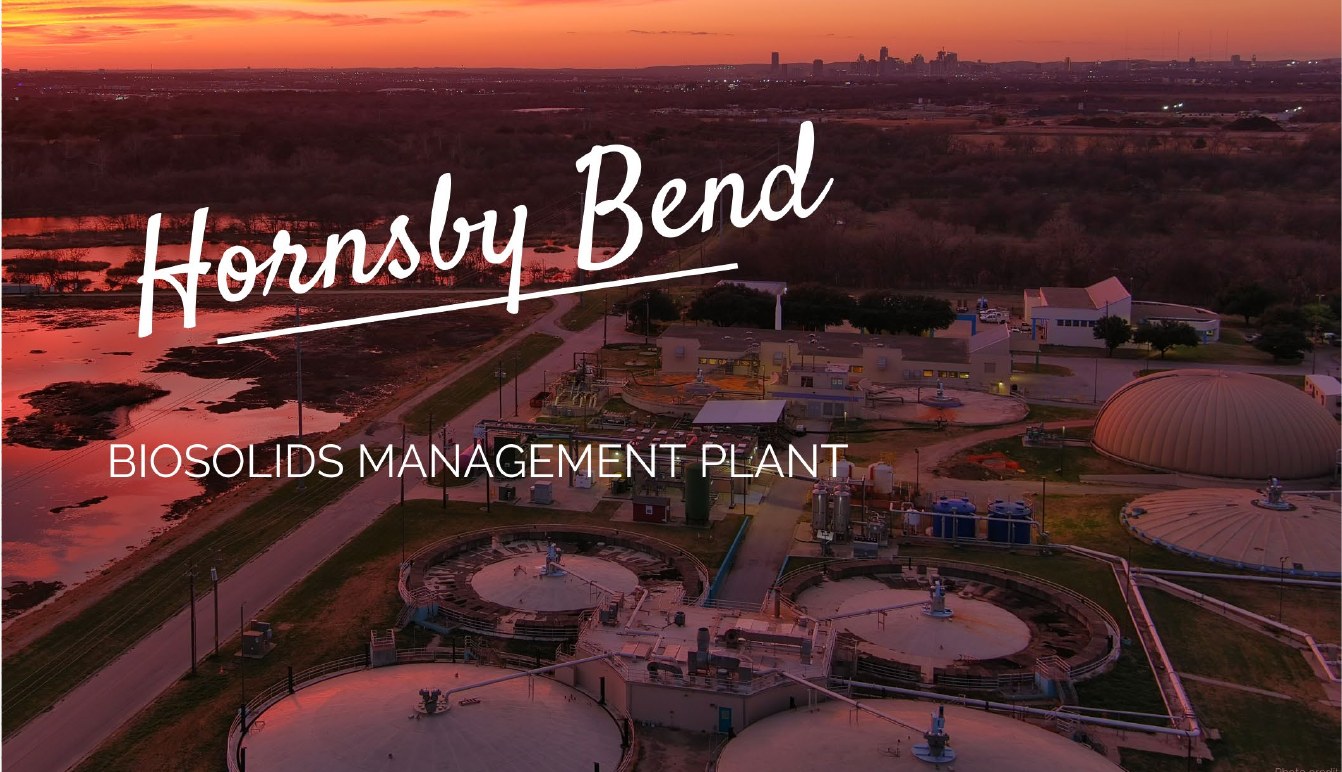
The plant that turns Austin’s sewage sludge into Dillo Dirt compost needs new equipment, and Austin Water is also lining up its share of the bill for moving pipes out of the way of the I-35 rebuild.
The city’s Water and Wastewater Commission, an 11-seat advisory board that reviews Austin Water contracts before they go to City Council, meets at 5:30 p.m. Tuesday, Nov. 10, 2026, at Austin Water headquarters in the Waller Creek Center, 625 E. 10th St., according to the agenda. The meeting can be viewed online on ATXN. Fifteen of the 20 items up for a recommendation are on the Council’s Nov. 19 draft agenda. The backup lists Dec. 3 for three others, including the Item 9 engineering amendment.
Items 8 through 11: Hornsby Bend. The Hornsby Bend Biosolids Management Plant sits on a 1,200-acre site along 3.5 miles of the Colorado River about eight miles east of downtown and treats biosolids, the solid material left after wastewater treatment, from the city’s two regional treatment plants, according to the backup for Item 8. The plant dates to the 1950s.
Item 8 is a $22.4 million construction contract with Matous Construction Ltd. to replace the plant’s headworks, the screening system that is the first step in treatment, and to add a new sludge receiving station. Staff says the existing equipment has limited capacity and has exceeded its useful life. The amount includes a $2,038,200 contingency, and the contract allows 950 days for completion. Matous was the lowest responsive bidder of two.
Item 10 is a second Matous contract, for $32.9 million, to build an ammonia removal facility, according to its backup. The plant does not discharge into waters of the United States under its state permit, and a side-stream treatment plant and a pond system now treat the ammonia and nitrogen left from processing; the new facility is meant to cut those levels significantly. The contract includes a $6.07 million allowance for a complete de-ammonification system and allows 660 days. Staff wrote that without it, the ponds alone “may not achieve the desired environmental outcomes.”
Two engineering amendments ride along. Item 9 adds $3,213,451 to STV Incorporated’s contract for construction-phase services on the headworks, for a total of $6,269,561 in the item language; the authorization history table in the same document totals $6,038,951.11. Item 11 adds $1,658,313 to Stantec Consulting Services’ ammonia project contract, for a total of $3,775,154, according to its backup. Together, the four items total about $60.2 million.
Items 14 through 17: I-35 pipe work. Under federal rules, the Texas Department of Transportation pays to move water and wastewater lines that conflict with its I-35 Capital Express Central project. Austin Water pays for betterments, upgrades it asks TxDOT to build while the lines are being moved, such as larger or added pipe, valves and manholes.
Four advance funding agreements would cap Austin Water’s payments to TxDOT at about $51 million, including 10% contingencies:
- Item 14, the downtown segment from Martin Luther King Jr. Boulevard to Holly Street: up to $9,104,119, with bids scheduled to open in February 2027, according to its backup.
- Item 15, Packages 1 and 2, north of Martin Luther King Jr. Boulevard: up to $10,177,475, with relocations in city streets between East 46th Street and Manor Road, according to its backup.
- Item 16, Packages 3, 4 and 7, Holly Street to Martin Luther King Jr. Boulevard: up to $20,497,444, according to its backup.
- Item 17, Packages 5 and 6, Holly Street to Lady Bird Lake: up to $11,193,227, all for wastewater lines, according to its backup.
The backups estimate the total utility work in the four agreements, including TxDOT’s share, at about $275.4 million. TxDOT’s letting, or bid process, for Packages 1 through 7 is tentatively set for March 2027, and the backups say all dates depend on TxDOT’s design and construction contracts. Item 22 is a staff briefing on the relocations.
Items 2 and 3: Paying off debt early. Austin Water is asking to defease, or use cash to retire, some of its outstanding revenue bonds, putting $43.2 million toward the payoff, according to the resolution backup. The money would come from $30 million in impact fees, the one-time charges new development pays for water and sewer capacity, and $13.2 million in operating funds. Staff says the move would lower debt and interest costs and ties it to “rate stability over the next few years.” The budget amendment moves $9.2 million from Austin Water’s capital improvement plan into its bond redemption fund to make the money available for the payoff. Final savings depend on market conditions and which bonds are chosen, the backup says.
Items 6 and 7: Winding Trails near State Highway 130. Austin Water would reimburse developer Z Modular up to $1.85 million for an oversized water main and up to $4.5 million for oversized wastewater lines and a lift station, according to the water and wastewater backups. The roughly 260-acre Winding Trails East and West project at 7308 N. FM 973 is in the city’s extraterritorial jurisdiction, the unincorporated area outside city limits where Austin has some development authority. It proposes about 1,254 apartments plus office, retail, restaurant, hotel and sports field space. The city asked for the larger pipes so they can serve other properties in the area, and it pays only its proportionate share.
Also on the agenda
- Items 4 and 5: Water and wastewater service requests for a 10-acre tract at 10656 N. FM 620 in the Drinking Water Protection Zone, the city’s designation for watersheds with stricter development rules. The agenda says the owner pays the connection costs.
- Item 12: A $1,598,833 contract with Facilities Rehabilitation Inc. for wastewater line work along Pino Lane starting at Dove Springs Drive, in Southeast Austin’s 78744 ZIP code, to relieve a capacity bottleneck, according to its backup. The agenda item language describes it as water collection work.
- Item 13: A contract with Polydyne Inc. for a drinking water treatment chemical, up to $3,245,000 over five years.
- Item 19: An added $210,000 for zebra mussel control at water treatment plants, bringing that contract to $5,150,724.
- Item 23: A briefing on Austin Water’s environmental office and the Balcones Canyonlands Preserve. The presentation says the regional endangered-species permit behind the preserve expired in May 2026, a point the Dispatch reported last week.
- Items 24 and 25: Briefings on Austin Water’s third-quarter 2026 water management strategy implementation report and a preview of the 90th Texas legislative session.
How to take part. In-person speakers may sign up at the meeting and get three minutes, according to the agenda. Questions go to commission liaison Vicky Addie at 512-972-0332 or vicky.addie@austintexas.gov. More information is on the commission’s page.