The committee sent reporting rules, a community advisory group and a response deadline on No Wrong Door — a program that coordinates care for about 100 people who cycle through jail, ERs, ambulances and the street — to the full City Council for Oct. 22. It also heard how Central Health plans to spend tens of millions more on mental health care paid in part by this year’s hospital-district tax increase, and it told staff to show where social-services contract clients live by district and ZIP code.
The Austin City Council’s Public Health Committee on Wednesday, Oct. 7, recommended that the full Council set outcome tracking, legislative coordination, a community advisory group and an Oct. 30 deadline for answering civil-liberties groups’ concerns about the No Wrong Door crisis program.
Chair Vanessa Fuentes presided at City Hall, with Vice Chair Marc Duchen and Council Members José Velásquez and Ryan Alter, the committee’s other members, attending. The committee advanced three motion sheets. A Fuentes sheet, approved without objection, directs staff to track housing, behavioral-health treatment, service connections and other outcomes for No Wrong Door participants and give the committee quarterly reports (EDIMS 482704). A Velásquez sheet, also approved without objection, asks the city manager to update Council on No Wrong Door legislation, convene a mayor-plus-committee sub-quorum on legislative goals, and answer the “No Wrong Door Concerns” letter from VOCAL-TX, the Capital Area Private Defender Service, the ACLU of Texas and allies by Oct. 30, 2026 (EDIMS 482706).
A second Velásquez sheet (V2) drew the meeting’s only objection. It recommends a No Wrong Door Community Advisory Group whose named members include the ACLU of Texas, CAPDS, Texas Civil Rights Project, Disability Rights Texas, Texas Harm Reduction Alliance and the Travis County Public Defender’s Office, with membership and a first meeting reported by Nov. 20, 2026, and initial policy recommendations at the committee’s first 2027 meeting. It passed with three in favor; Duchen objected (EDIMS 482707). The No Wrong Door motions story has more on the debate. Council Member Krista Laine joined as a guest and said she was not voting.
Several public speakers urged the committee to slow the program or tighten civil-liberties safeguards, echoing the Council’s Oct. 6 work session. Speakers identified in the meeting transcript included Kate Graziani and Carrie Ann Smith of VOCAL-TX; Melissa Shearer, Travis County’s mental health public defender; Katie Jo Muncy of the Capital Area Private Defender Service; Savannah Lee of Equity Action; a speaker for the Texas Civil Rights Project; and Joshua Delosa of the Phoenix Project. Defense lawyers said they have been left out of case staffings; advocates said police involvement risks turning service referrals into criminal-system contact; and supporters of a slower rollout asked for clearer consent and outcome measures. Staff backup includes No Wrong Door memos (EDIMS 482577, 482224).
Central Health’s mental-health plan. Central Health CEO Dr. Pat Lee, Board of Managers secretary Dr. Manuel Martin, Perla Cavazos, Monica Crowley, Sydney Harris and Alicia Ramirez presented the hospital district’s Year of Access results and FY27 plans (presentation EDIMS 482578). Slides say Central Health served more than 200,000 Travis County residents (about 1 in 6), cut new-patient primary-care wait times to about eight days at CommUnityCare Open Access pilot sites, and recorded a 69% reduction in hospital stays among medical-respite participants in the program’s first year. For FY27, the deck cites $127.5 million for crisis and recovery care, including $54 million in new mental-health investments funded in part by revenue from a 6% tax-rate increase: $33.1 million toward 22 inpatient psychiatric beds and 10 psychiatric emergency-department bays, and $16 million toward a mental health crisis center with partners (including $3 million tied to the Sobering Center). Presenters linked that continuum to No Wrong Door’s need for beds. Central Health’s Strategic Planning Committee and Executive Committee meet Oct. 14.
Other business. Daniel Culotta, assistant director with Austin Budget and Organizational Excellence, briefed the committee on the social-services “reset” tied to several Council resolutions, including a rubric for prioritizing funding and a planned January 2027 work session (memo EDIMS 482222; presentation EDIMS 482702). Fuentes’s adopted motion directs staff to report, where feasible, where people served by each contract live — by Council district, ZIP code and/or census tract — when recommendations go to full Council (EDIMS 482703). The committee then adjourned after a brief future-items discussion.
The meeting page, agenda (EDIMS 482218), meeting transcript (EDIMS 482984) and video are posted on the city’s website. The Dispatch previewed the meeting.
The No Wrong Door recommendations go to the full City Council, which is scheduled to take them up as Item 45 at its Oct. 22 meeting.
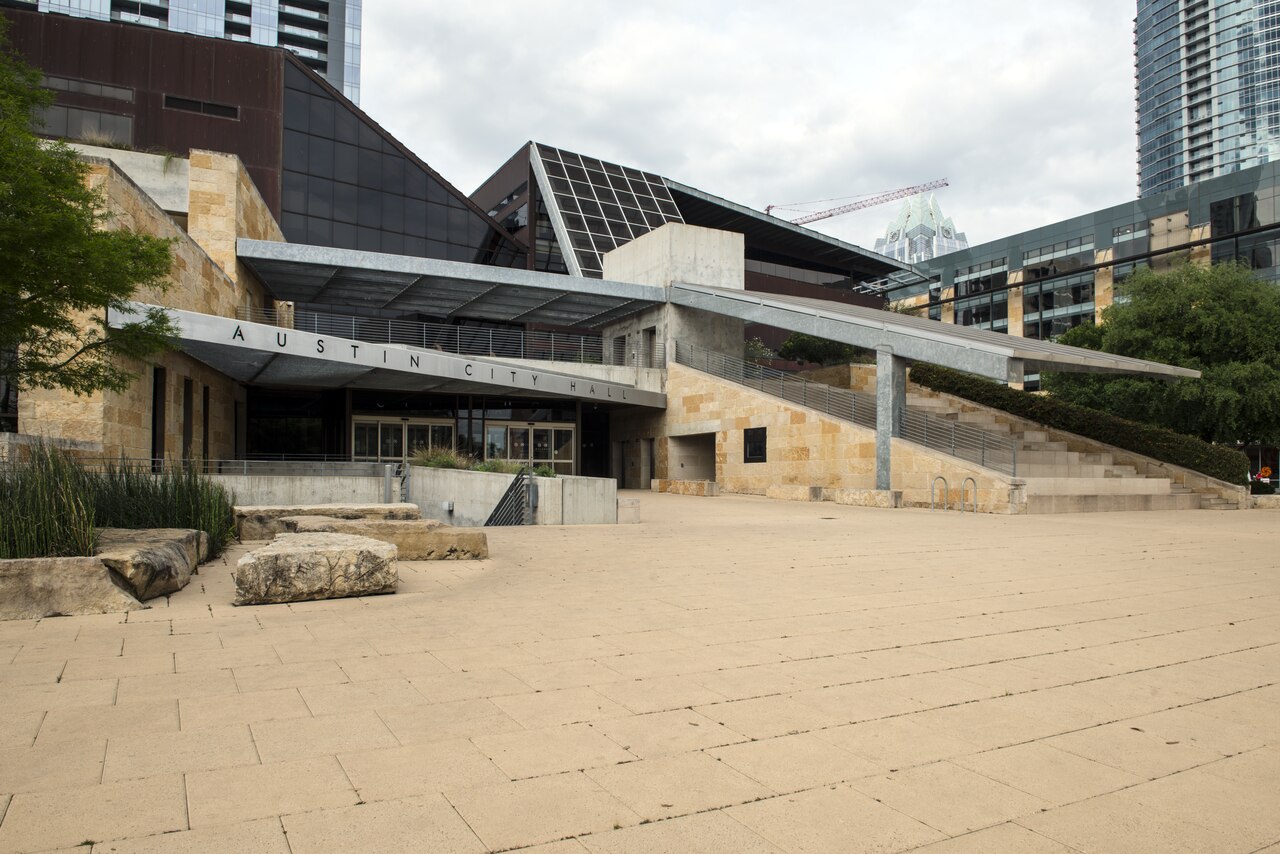
Photo: Austin City Hall and Public Plaza. Carol M. Highsmith, Library of Congress (LCCN 2014632502), public domain, via Wikimedia Commons.