If you or someone you know cycles through jail, emergency rooms and the street, No Wrong Door is the city’s attempt to coordinate their care across about 17 agencies — including police. On Oct. 7 the Council’s Public Health Committee voted to send the full Council a package of reporting rules, a community advisory group and a deadline for answering civil-liberties groups. That package is drafted as Item 45 on the Oct. 22 regular meeting agenda.
The Austin City Council’s Public Health Committee on Oct. 7 recommended that the city create a No Wrong Door Community Advisory Group drawing on civil-liberties and defense organizations, over the objection of Vice Chair Marc Duchen, and set an Oct. 30 deadline for answering those groups’ written concerns about the crisis program.
Three motion sheets on the item moved forward. Together they match the draft Council resolution listed as Item 45 (File 26-2940) on the Oct. 22 draft agenda: outcome tracking and quarterly reports to the committee; legislative updates and a mayor-plus-committee sub-quorum; a written response by Oct. 30, 2026, to the coalition letter titled “No Wrong Door Concerns”; and a Community Advisory Group with membership and first-meeting date reported by Nov. 20, 2026.
The advisory-group sheet, Velásquez motion sheet 2 (V2), passed with three in favor; Duchen objected (EDIMS 482707; earlier draft 482705). Council Member Ryan Alter seconded. The sheet recommends that Council direct the city manager to create a group to meet regularly on policy, legislative and operational decisions. It says members should include the ACLU of Texas, CAPDS, Texas Civil Rights Project, Disability Rights Texas, Texas Harm Reduction Alliance, the Travis County Public Defender’s Office “and other organizations as deemed appropriate.” The manager would report the final membership list and first-meeting date by Nov. 20, 2026, and the group would bring initial policy recommendations to the committee’s first meeting of 2027.
According to the meeting transcript, Duchen said he supported answering the coalition’s concerns but opposed forming an advisory group drawn from the organizations that signed the letter. He said he would rather start from criteria for which of the many nonprofits that touch the space should be included, and that naming letter-signers risked a group that feels heard without producing action. Velásquez said the sheet’s language is “should include” and does not limit other participants. Chair Vanessa Fuentes, who leads the four-member committee, then recorded Duchen as objecting and announced three in favor.
Velásquez motion sheet 1, approved without objection with Duchen’s second, directs the city manager to keep Council updated on No Wrong Door-related legislation; convene a sub-quorum of the mayor and committee members to guide legislative objectives; and respond by Oct. 30, 2026, to the letter from VOCAL-TX, Capital Area Private Defender Service, Texas Civil Rights Project, ACLU of Texas, Equity Action, Texas Harm Reduction Alliance, United Workers of Integral Care and others (EDIMS 482706).
The Fuentes motion sheet, approved without objection with Velásquez’s second, directs staff to track outcomes for people identified and engaged through No Wrong Door, including connections to housing by type, behavioral health treatment through Integral Care or other providers, connection to care and services by agency, and other resources such as Veterans Affairs (EDIMS 482704). That would add to metrics listed in the Oct. 6 briefing appendix: resource connections, local coordination, fewer repeat law-enforcement crisis contacts, less public-safety time on scene, length of stabilized behavior and prioritized behavioral-health resources. Staff would report quarterly to the committee with that data plus programmatic, legislative or operational updates.
Council Member Krista Laine, attending as a guest, said she does not vote on the committee. She argued for a clearer “phase two” in which mental health professionals, not only specialized officers, become the main contact for people leaving custody, and for routing changes so clinicians decide when an officer is needed. She also questioned whether some reporting mandates duplicate sub-quorum and Public Safety Committee briefings the Council can already request.
Public speakers pressed for slower rollout and clearer limits on police. Kate Graziani and Carrie Ann Smith of VOCAL-TX urged the city not to fast-track the program. Melissa Shearer, Travis County’s mental health public defender, and Katie Jo Muncy of CAPDS said defense counsel need to be in the room when cases are staffed. Savannah Lee of Equity Action and a Texas Civil Rights Project speaker raised consent, data-sharing and criminal-system risks — themes that match the coalition letter the Oct. 30 response deadline covers.
Staff backup includes combined No Wrong Door memos (EDIMS 482577, 482224) and the Oct. 6 work-session presentation (482576). Robert Kingham, Austin Community Court administrator, was present for questions after the motions; the meeting transcript does not show new results figures beyond the Oct. 6 briefing. The meeting’s transcript (EDIMS 482984) and video are posted. The Dispatch previewed the Oct. 6 work session and the committee meeting.
Committee recommendations do not change police or city policy by themselves. The Oct. 30 letter-response date and Nov. 20 advisory-group reporting date are directions to the city manager that take effect only if Council adopts them or substitutes its own deadlines. The full Council is scheduled to take up the package as non-consent Item 45 on Oct. 22 and can adopt, amend or reject it.
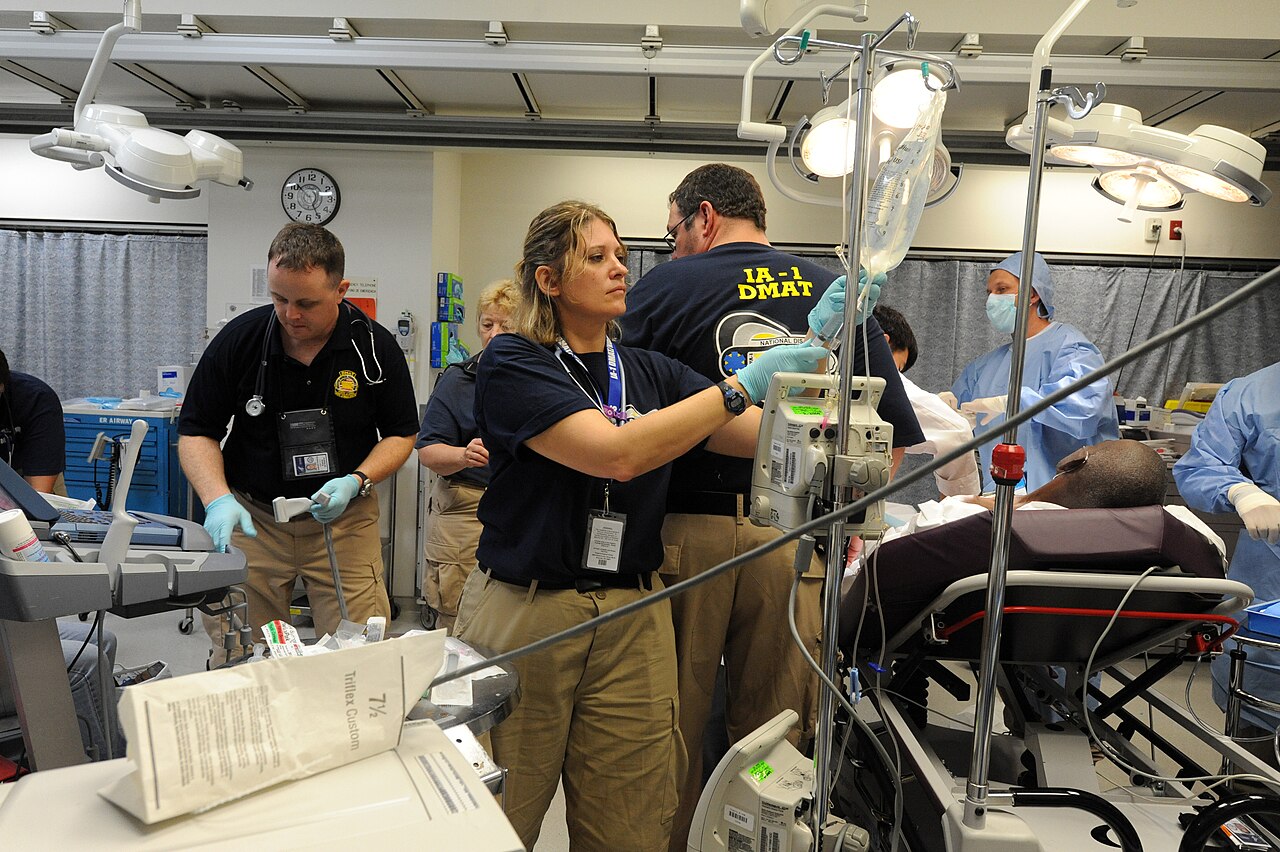
Photo: Members of a Disaster Medical Assistance Team and a medical flight crew transport a patient in Galveston, Texas, Sept. 19, 2008. FEMA photo by Jocelyn Augustino, public domain, via Wikimedia Commons.
